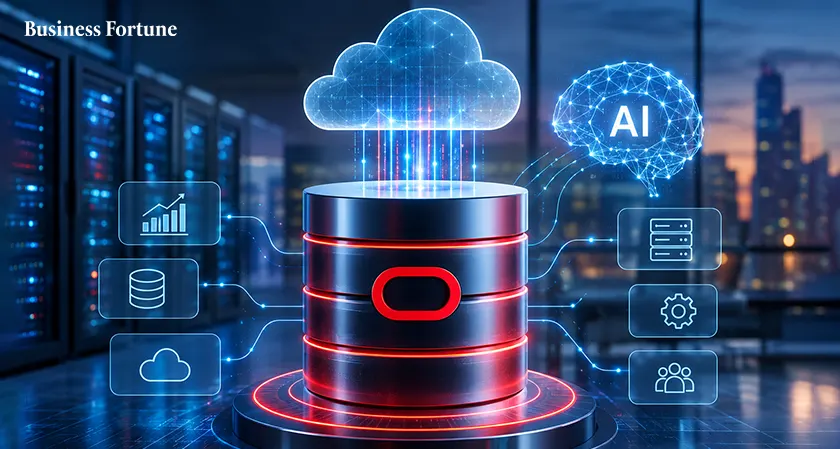
Oracle AI Database 26ai reaches most customers as a patch, not an upgrade. This 2027 guide covers features, security, support dates and trade-offs.
Oracle AI Database – What you need to know in 2027?
Oracle AI Database 2027(26ai) is currently Oracle’s longest term support release, with most existing customers receiving it through patch updates. The release was announced in October 2025, with new security blueprint for securing AI agents added at Oracle AI World this week.
With budget time on the horizon, Oracle has really ramped up their enterprise AI focus.
What’s Oracle AI Database and what’s different to 23ai?
Essentially the same engine but with more functionality.
As Oracle explains 26ai is now the replacement for Oracle Database AI 23ai, with customers upgrading via the October 2025 release update. This means no database upgrades or application re-certification. Whilst the name might be misleading, Oracle has been more honest with the version. The January 2026 on-premises release is version 23.26.1., with AI embedded within the database kernel.
Oracle Database management has updated their documentation to show over 300 new features, including AI Vector Search, JSON Relational Duality and RAFT based distributed replication. Oracle’s cloud services were first to get 26ai, with Autonomous AI Database, Exadata Database Service, Base Database Service, Oracle Database@Azure, Oracle Database@Google Cloud & Oracle Database@AWS.,meaning any Oracle cloud database is going to be an easy upgrade path.
For on premises Oracle released the Enterprise Edition for Linux x86-64 in January 2026. There’s no date yet for other OS, however the free edition supports ARM Linux & Windows for developers.
What are the key features of Oracle AI for businesses?
Trust, Data Access, Integration, Operations and Scale.
How can AI agents securely access data in the company?
This is where Oracle has their strongest argument. Teams can create and manage their own AI agents with Select AI Agent within Autonomous AI Database. By exposing the tools via an MCP server they can be accessed by external clients using OAuth or bearer tokens. This is a quick solution but can be a risk factor. If an agent is connected using either MCP or NLTOS then they could potentially circumvent any rules within your application code.
Oracle’s Deep Trust AI Architecture puts this into the database. Deep Data Security ensures that any rules for end user access are enforced within every SQL query. The end user will be authenticated using a signed token from the corporate directory. SQL Assertions ensure any rules for your business are enforced, such as limits on how much can be spent.
"AI trust is the biggest challenge we have today", said Juan Loaiza, Executive Vice President AI Database Technologies.
Can I search semantically and via SQL?
Yes! Oracle database innovations has created a new feature called Unified Hybrid Vector Search. This allows vector searches with relational, text, JSON, graph and spatial predicates. You’ll get results from documents, images & table rows. AI Vector Search is included free of charge.
If we look at PostgreSQL it’s the obvious competitor. It has a de facto standard for AI apps with it’s pgvector extension. From Stack Overflow data it’s the most popular database for developers, however Oracle still holds the top spot on DB-Engines. The vector index isn’t going to be the deciding factor. "Vector indexing is now a commodity" says theCUBE Research. The difference comes from how it’s managed. You have one security policy for relational, JSON, graph & vector data.
Lakehouses and other clouds?
Autonomous AI Lakehouse can read and write Apache Iceberg tables. It works with Databricks and Snowflake. AI Data Catalog can connect to external catalogs and non-Oracle databases and query in real-time. Oracle Database@AWS is an Oracle cloud database service, running within Amazon data centers. It became generally available in July 2025 and new regions in Frankfurt, Tokyo & Ohio were added in December. The service includes 26ai Oracle AI features like vector search.
Will this change how I administer databases?
To an extent. Oracle state that Autonomous AI-powered databases will include security patches for the whole engine, OS, storage & firmware. Real-Time SQL Plan Management will automatically correct any regression in execution plans. The conference agenda states that DBA’s are moving from managing individual databases to managing a service. Everyday administration will be easier with Oracle Autonomous databases. However on-premises teams will still be responsible for patching.
Is performance important for Oracle enterprise AI?
Yes. They have True Cache which provides a transactionally consistent mid-tier cache. Exadata provides vector search offloading to storage. And Globally Distributed Database provides less than 3 second failover with zero data loss.
What does the 2027 calendar look like?
|
Date |
Milestone |
Why it matters? |
|
October 2025 |
26ai announced; 23ai customers apply the October release update |
Cloud customers may already run it |
|
January 2026 |
Linux x86-64 on-premises release (RU 23.26.1) |
First broad on-premises path |
|
October 26, 2026 |
Deep Trust AI Architecture announced |
Database-enforced rules for agents |
|
End of February 2027 |
Oracle's free or discounted security and patching tools offer ends |
Deadline to trial the tooling |
|
July 31, 2027 |
21c Premier Support ends; no Extended Support |
21c estates must pick a long-term release |
|
December 31, 2029 |
19c Premier Support ends; paid Extended Support runs to December 31, 2032 |
Full support ends |
|
December 31, 2031 |
26ai Premier Support ends; Extended Support not yet set |
Planning horizon for new deployments |
Where can things go wrong with Oracle AI Database?
There are three areas to consider:
Platform
Oracle currently only have Linux x86-64 as a general purpose on-premise platform. Windows and other OS’s are not announced.
Cost
While there is no cost for feature licensing, there are costs associated with the hardware/cloud usage.
Lock-in
Oracle state this is not the case with their open standards such as Iceberg tables, MCP, ONNX embedding models and multiple LLM providers available. However some remain sceptical (The Register).
How should I get started with Oracle AI Database?
Oracle AI is best implemented in a small way for businesses.
Inventory
Identify if the estates are on 19c, 21c or 23ai. Also what OS they are on. Then identify what Oracle database solutions support.
Prototype
Oracle AI Database Free is available on Linux x86, ARM Linux and Windows. Always Free Autonomous AI Database is available for trial.
Pilot
Implement one retrieval workload using existing Oracle data. Compare to pgvector baseline.
Test
Try to access data that should not be accessible by implementing one agent using MCP. Deep Data Security and SQL Assertions should prevent this.
Set a date for early 2027. Identify what you want to do before the discounted tools window ends in February and before 21c support ends on 31st July.
More to Know
Oracle AI Database is a viable platform to implement if you already have critical data stored in Oracle and want your enterprise AI to utilise this data without duplication. The main reason would be the enforced security within the database for agents (the most impactful innovation Oracle have had recently to their databases). Oracle AI technology is viable. But there are risks to consider. There can be limitations to the platform, uncertainty around costs in the long-term and lock-in. Start with a pilot in early 2027. Business Fortune asks readers to make decisions based on measured results. Let the 21c and 2029 dates dictate your timeline.
FAQs
Why should businesses use Oracle AI Database?
Vector search, agents and security can all be implemented within the engine that stores your mission-critical data. This means no duplication of data. AI Vector Search is included for free. If you do not have an existing Oracle estate this is the weakest reason.
What are the features of Oracle AI Database?
Over 300 new features. AI Vector Search, Unified Hybrid Vector Search, Select AI Agent, MCP server, Private Agent Factory, JSON Relational Duality, True Cache, SQL Firewall, Quantum Resistant Encryption, Global Deployment and Iceberg Lakehouse support.
How can businesses use Oracle AI Database?
Most will start with semantic searching, querying operational data using agents via MCP, natural language reporting and querying Iceberg data in the lakehouse. Start with one workload using a free edition.
Which Oracle AI Database features matter most to businesses?
Enforced security and controlled access to agents (Deep Data Security, SQL Assertions, MCP with Select AI Agent). Then hybrid vector searching on real-time data. Then lakehouse access. Admin and performance features are important once you scale your pilots.
Do businesses on Oracle 19c need to upgrade to Oracle AI Database in 2027?
No. 19c has Premier Support until December 31st 2029. 21c is an exception and has Premier Support until July 31st 2027. Only upgrade earlier if you need the features in 26ai for AI workloads.


.webp)




























Comments