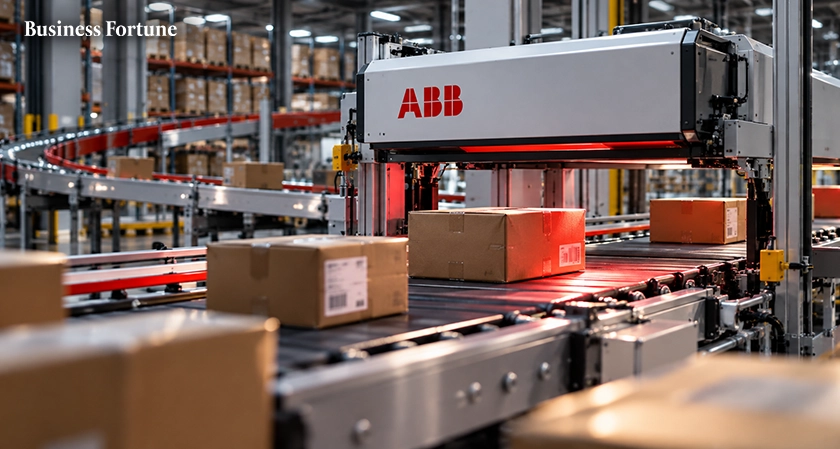
ABB’s Fashion Inductor brings AI into robotic sorting, promising faster deployment and a 75% reduction in engineering effort.
What if warehouse robots could handle changing products with less effort? ABB Robotics is making this possible by upgrading its Fashion Inductor with AI Robot Trainer, announced on October 15, 2026. The new upgrade makes it easier for companies to design and improve their robotic sorting systems reducing the engineering effort by up to 75%.
It is quite difficult to sort clothing items and accessories since their size and packaging keeps on changing. ABB’s new AI-powered technology is designed to help robots handle these changes more easily, without requiring specialist AI knowledge.
AI Helps Robots Handle Changing Products
Fashion Inductor is built for sorting and transferring apparel items in busy logistics environments. According to ABB, the system can process up to 1,300 items per hour per cell, with picking accuracy targets above 99.5%.
With the inclusion of the AI Robot Trainer, pre-trained vision models that have been developed particularly for fashion applications are introduced. These vision models allow robots to identify objects and adjust to changes in products, packaging, and environment. System integrators can also retrain the AI for specific applications without needing deep expertise in artificial intelligence.
“Physical AI fundamentally changes what robots can do in industrial applications,” said Craig McDonnell, Managing Director, Business Line Industries at ABB Robotics. He explained that highly variable tasks offer major opportunities for this technology, helping businesses deploy automation faster, reduce project risks, and maintain performance over time.
Robots Can Improve Through Continuous Learning
While other systems might require major modifications whenever the situation changes, the improved Fashion Inductor will continue to get better all through its lifetime. This closed loop system tracks the performance of the robot, detects any unusual results, generates new training data, and feeds the updated model back into the robot. This helps the system adapt to new demands instead of being dependent solely on its initial configuration.
It would be particularly useful in fashion warehouses that deal with fluctuating demands for new product lines and different packaging.
A Digital Twin Makes Setup More Flexible
The upgrade also introduces a digital twin, a virtual replica of the module's software environment. It connects ABB's Application Controller Platform, Automatic Path Planning, AI Robot Trainer, and RobotStudio software.
This setup allows integrators to design, simulate, and validate applications before deploying them in production. It also supports third-party components, including grippers, giving businesses more flexibility when configuring their systems. ABB's OmniCore controller handles robot execution during production.
What Comes Next for Physical AI?
Fashion Inductor marks the first step in ABB Robotics' wider rollout of vision-based physical AI. The company plans to extend the AI Robot Trainer approach to additional vision-based applications through the first quarter of 2027.
According to Business Fortune, there is a need for flexibility in warehouses due to the changes in product mixes and increased requirements for speed. The next step will be to extend the use of these robots in other areas as well while maintaining the accuracy and efficiency.
Sources: https://www.abb.com/global/en/areas/robotics/solutions/functional-modules/item-picking-family/fashion-inductor https://www.abb.com/global/en/news/139480/prsrl-abb-robotics-brings-industrial-grade-physical-ai-to-fashion-logistics

.webp)





























Comments