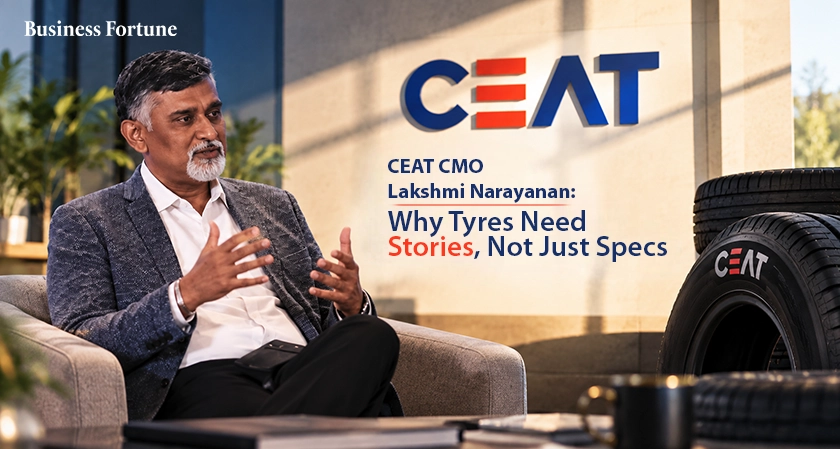
CEAT CMO Lakshmi Narayanan on cricket bets, AI's limits and turning a functional product into an emotional one.
CEAT CMO Talks About Tyre Company’s Emphasis on Emotion vs. Specs, Cricket Sponsorships and Role of AI in Its Marketing Strategy
The CEAT CMO Lakshmi Narayanan spoke about how the tyre brand’s marketing strategy creates emotional engagement with the Indian market by focusing on what the product enables as opposed to its performance characteristics in an interview that was recently held and published by Impact, a marketing trade journal.
In the conversation, Lakshmi Narayanan, Head of Global Marketing of CEAT’s (passenger, commercial and off-highway) vehicles speaks about storytelling, its cricket sponsorships and the role of artificial intelligence in his marketing strategy. The interview conducted by Impact’s Raaina Jain covers topics such as marketing strategies, media, influencers and CEAT’s future growth plans.
How do you think CEAT can market a “boring” product like a tyre?
I believe that for every vehicle that no matter how powerful or capable it is, there is only one element that comes in contact with the road or the terrain and that is the tyre. Control, confidence and control on the road emanate from this single point and for every driver, this is the deciding factor. This is emotional and the art lies in making the customer connect with this aspect of the product.
Why was it important to cast someone like Zoya Akhtar in CEAT’s advertisements?
One of the key points behind our recent advertisements, which also starred Zoya Akhtar, is relatability. A majority of the population deals with the fear of driving through bad weather or on wet roads. Over the past decade, we have switched from focusing on fear to confidence and from being transactional to aspirational. The change has enabled us to create stories around our products, which we feel is the new normal in marketing.
Did you see a shift in CEAT’s ad spends from traditional media to digital?
We are witnessing a change where the digital media’s share of voice has increased significantly, overtaking traditional media. However, I would not say that we are prioritizing one media type over the other as traditional media, especially TV, continues to offer unparalleled reach. However, what we have noticed is a change in the metric that matters; engagement has become more important than the volume.
Do you think CEAT collaborates with social media influencers in its marketing plans?
It depends on the category. Social media influencers are not relevant to us when it comes to something as serious as tyres. What we look for are individuals who can connect to our audience on social media and talk about 4x4s or bikes like an influencer because they embody the voice of their community and not necessarily because of their follower count.
What role do you think artificial intelligence plays in CEAT’s current marketing plans?
We believe that AI has a limited and specific role in marketing, particularly in analysing data and generating content, but we also believe that it is the human heart that makes marketing beautiful and relatable.
Why is cricket such an important vertical for CEAT?
We have always believed in associating with sports and we look at cricket sponsorships, including our long-standing association with Rohit Sharma, Harmanpreet Kaur and Yashasvi Jaiswal, as a part of our marketing strategy. Our cricket rating and strategic timeout in the IPL has helped us create a legacy that is hard to rival.
What do you think is CEAT’s biggest advantage when it comes to marketing?
We are a 100-year-old company that was founded in Italy in 1924 and has since been the premium tyre brand for India’s RPG Group, operating in more than 115 countries. Previously, I was the head of marketing at Asian Paints and also worked with Samsung India Electronics.
Business Fortune believes, Lakshmi Narayanan’s interview gives some insight into how CEAT plans to market its products in the future. By investing in creating emotional connections and focusing on long-term relationships with customers, the company aims to benefit from increased loyalty and advocacy. Additionally, the company will be relying on AI to help it create more targeted and relevant campaigns and leverage the power of data analytics including marketing automation, video analytics and social listening tools.
Sources
Impact


.webp)





























Comments