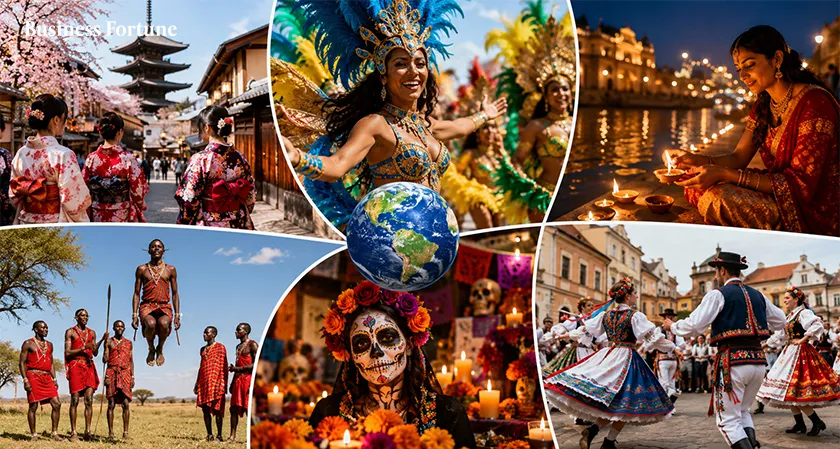
Top Cultural Traditions reveal how people celebrate life, honor ancestors, express faith and preserve identity through customs passed from one generation to another.
What if a festival can tell you more about a country than a history book? What if a simple meal, a flower, a decorated face or a candle in the dark can bear stories from long ago? That is the magic of Top Cultural Traditions.
Across the world, people celebrate life in unique and beautiful ways. Some of these traditions are riotous and flamboyant, bursting with colour, music and revelry. Others are more low key, moments of gathering and reflection when families or friends meet and share a meaningful experience.
These unique cultural traditions and customs are precious parts of people’s heritage and history, passed from generation to generation.
From blooming sakura in Japan to sugar skulls in Mexico, here are five interesting and famous cultural traditions from all around the world that will take you on a fascinating journey around our planet.
- Japan — Hanami
If you have ever wondered what it means to have a picnic under a blooming sakura tree, then you have probably experienced Hanami; an ancient Japanese tradition of viewing and celebrating the blossoming of the cherry trees and other flowering plants in spring.
Although blossom viewing customs are common in many regions and countries, Japan has its very own Hanami which usually sees families and friends or even coworkers gather for a picnic under the trees.
People love to celebrate this spring ritual by having food, drinks and chatting under blooming fluffy flowers. And if you want to witness Hanami, make sure to arrive early enough to snag a nice spot as it is a very popular event!
Celebrating Hanami has a deeper meaning, though. Just like the view it offers, Hanami is a transient experience of finding beauty and joy in something that will soon cease to exist. It is also part of the Japanese cultural philosophy of mono no aware which is all about finding a sense of loss and loneliness over the beauty and brevity of life.
- South Korea — Chuseok
One of the most important and cherished holidays in South Korea is Chuseok; a traditional lunar harvest festival.
For many people, the main symbols of Chuseok are family, gratitude, and commemoration of ancestors. Family members gather for a big dinner where Songpyeon, a traditional Korean half-moon rice cakes with various fillings such as sesame seeds or beans, is served.
It is believed that the shape of Songpyeon was chosen to resemble the full moon, a symbol of reunion and gratitude. Koreans also express their appreciation of their loved ones and ancestors during family gatherings and special rituals, which usually also involve visiting the family graveyard. Apart from Songpyeon, families typically gather in one place and arrange food stalls, a wonderful local tradition that warms the heart. Moreover, since Chuseok usually falls around the most busy and stressful time of the year, people enjoy getting together and relaxing for a while.
It is no surprise that such cultural traditions are so dear to Koreans. After all, in today’s busy and crowded world, who doesn’t long for home, family and friends?
- Ireland — St Patrick’s Day
Few cultural traditions can boast of such success and popularity as St. Patrick’s Day.
First of all, it is a religious holiday which is dedicated to St. Patrick, the patron saint of Ireland. March 17th is his day of commemoration and the festive events start on the weekend before it.
Over the years, the holiday has greatly evolved; from a purely religious festival of St. Patrick to a large scale event symbolizing embracing Irish roots and identity. From bright parades with bands and dance groups in costumes and traditional dresses to pubs blasting traditional Irish music it is now celebrated by Irish people and other nationals around the world.
As St. Patrick’s Day is an official holiday in Ireland, people can participate in various events organized in the city, such as traditional dancing, playing of the Bodhran (traditional Irish instrument), singing of songs, tasting Irish coffee and food and much more.
But what makes St Patrick’s Day even more incredible is its rich and interesting history. St Patrick’s Day started out as a Catholic holiday, which it still is to this day although the public, secular part of the day has blossomed into something much bigger. So no matter where you are, you are likely to witness or participate in some St. Patrick’s Day festivities; after all, it is a worldwide phenomenon!
- Mexico — Día de los Muertos
When you first hear about the Day of the Dead or Día de los Muertos, it may appear to be a dark and morbid custom with ghosts and skeletons; but it is really much more upbeat and joyous tradition, centered around family and celebrating the beautiful memories of those who have passed away.
The whole event involves creating altars (Ofrenda) with pictures, candles, flowers and food (particularly marigolds) as well as colorful sugar skulls called Calaveras — a traditional symbol of the holiday.
On one hand, it is a great chance to remember and honor those who are no longer with us. On the other hand, it is a vibrant and exciting tradition with unique crafts, food, decorations, parades, dancing and music. It really is a celebration of the lives that once were and of the family and community that continues to support each other, no matter what.
The Day of the Dead is not simply just one of the most fascinating traditions of Mexico; it is a truly unique cultural experience, which shows the world that death is not the end.
- Guatemala — Semana Santa
There exists an outstanding cultural tradition, which turns busy streets into colorful altars of painted sawdust, flowers, vegetables and fruits; an awe inspiring sight and a great way to engage with some interesting history and local faith.
This is the Semana Santa (Holy Week) in Guatemala, a unique opportunity to see some of the most significant and sacred traditions of Guatemala’s past.
Although it takes place throughout the country, the city of Antigua Guatemala is especially famous for its Semana Santa celebrations; more specifically for the artistic floor carpets made of sawdust, called Alfombras.
These astonishing creations can depict flowers, animals, religious scenes or any other themes. The most intriguing part, however, is that these lovely carpets are intended to be stepped on and defiled as part of holy processions which take place across the country.
Despite the somewhat sad ending of this captivating spectacle, it is definitely one the most stunning cultural traditions Guatemala has to offer.
Why Do Cultural Traditions Matter?
We can all see ourselves thinking traditions are just outdated habits; however in reality they can be surprisingly exciting.
-
Traditions can give the roots children have and give families something to bind over.
-
Traditions also provide for communities to pass down their languages, food, music, clothing, stories, beliefs or values.
-
Traditions all provide continuity.
The world around us is changing constantly, as cities are built and abandoned, technology advances, people and their lifestyles change and a tradition is a way for people to connect to the past.
Traditions also change.
A festival could have started as a purely religious holiday, but evolved into a national celebration; a harvest festival could have been a way for families to bond, but become an opportunity for people to reunite across the community; and a local tradition could have brought people together across the world.
This is what makes cultural practices around the world so interesting.
A Few More Traditions Worth Discovering
The above traditions mentioned above are the beginning.
India's Diwali, for instance, is all about lights and color, while Brazil's Carnival is all about music and dance, with extravagant displays of public art. In Thailand, Songkran is about water, as well as ushering in the New Year. Meanwhile, Hogmanay is the Scottish equivalent of New Year, where different traditions are used to mark Hogmanay.
In Spain, La Tomatina is a food fight between crowds of people and Timkat in Ethiopia is a wonderful Christian holiday. In China, Lunar New Year, as well as in many Chinese communities around the world, is a wonderful holiday full of eating, decorating the house, and giving gifts to each other and many more.
Every Tradition Has A Story Behind It.
Some have been around for thousands of years, whereas some are quite recent innovations. Some are very religiously charged, whereas others have become more secular over time. Some are famous around the world, whereas others are only known by a small group of people. This is what makes exploring different traditions so fascinating: no matter how different they may seem from yours, there is always something you can find interesting or relatable: some traditions are strongly related to family, some are about friends and many are about celebrating life and moving on when it comes to an end.
There is no shortage of interesting cultural traditions to explore beyond the usual postcard souvenirs or the random mentions in magazines and newspapers.
The Top Cultural Traditions are fascinating precisely because they introduce us to new people and their cultures and show us how they remember the past, enjoy the present and plan for the future. Every tradition is an opportunity to learn something new and exciting about the world and the people in it.
Business Fortune says that the next time you come across a strange tradition, instead of asking what it is or where it came from, you could wonder about what it is all about and what it could teach you.
FAQs
What are the Top Cultural Traditions around the world?
Some of the most famous traditions include Hanami in Japan, Chuseok in South Korea, St Patrick's Day in Ireland, Día de los Muertos in Mexico, Semana Santa in Guatemala
Why are cultural traditions important?
Cultural traditions keep history alive, strengthen communities, pass on knowledge from one generation to the next and give people a sense of belonging.
Which cultural tradition is associated with cherry blossoms?
Hanami is a Japanese tradition of viewing and celebrating flowers and cherry blossoms in particular.
What is the purpose of Día de los Muertos?
Día de los Muertos is a Mexican holiday meant to remember deceased friends and family members.
Are Indigenous traditions the same across Native American communities?
No, because Native Americans are actually a group of indigenous people consisting of hundreds of tribal nations, each of which have their own unique cultures, histories, languages and traditions.


.webp)




























Comments