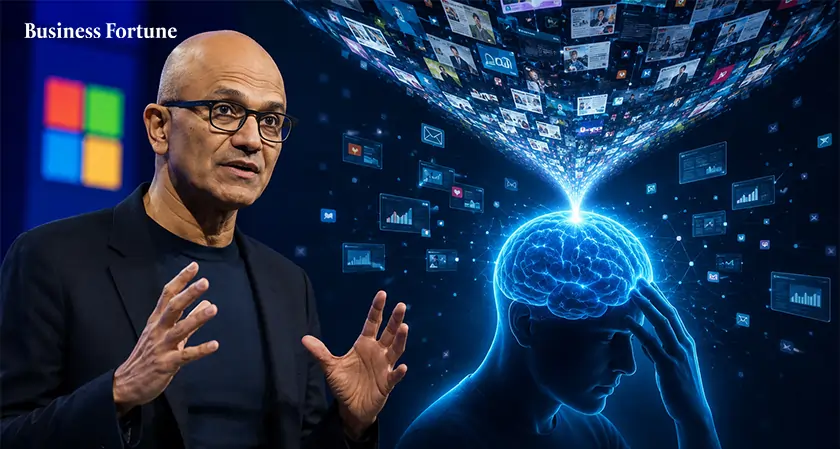
Microsoft CEO Satya Nadella highlights AI risks as companies may lose proprietary knowledge, raising concerns over control, trust, and future business advantage.
Microsoft CEO Satya Nadella has warned that businesses adopting artificial intelligence may unintentionally expose their most valuable knowledge assets. Highlighting the Reverse Information Paradox, Nadella explained that enterprises must build stronger trust boundaries to use AI while protecting the proprietary insights that make them competitive.
AI Adoption Creates New Knowledge Risks
Nadella said companies increasingly depend on AI models but may reveal internal knowledge through prompts, corrections, and agent interactions. This information can become valuable learning material for AI providers, creating an imbalance where businesses contribute expertise without maintaining full ownership.
He explained that organizations effectively pay twice for intelligence: once through financial investment and again by sharing the knowledge required to make AI systems more effective.
Reverse Information Paradox Challenges Ownership
The Reverse Information Paradox reflects a growing concern in the AI ecosystem. While companies seek advanced models to improve productivity, they risk transferring institutional knowledge outside their control.
Nadella noted that AI systems learn from user-generated interactions, including corrections and evaluations. Over time, these small contributions can develop into strategic insights that competitors could never easily acquire.
Key concerns raised by Nadella include:
-
Proprietary knowledge exposure through AI interactions
-
Limited visibility into model learning processes
-
Growing imbalance between users and providers
-
Need for stronger enterprise AI boundaries
-
Importance of independent evaluation systems
Building Trust Boundaries for AI Future
Nadella argued that enterprises need greater control, flexibility, and ownership when deploying AI technologies. Companies should maintain private evaluation systems, protect organizational memory, and separate AI orchestration from individual models.
The Microsoft CEO Satya Nadella vision suggests that future AI success will depend not only on model capabilities but also on protecting the knowledge businesses create. The Reverse Information Paradox highlights the need for responsible AI frameworks where companies can benefit from innovation without sacrificing their competitive advantage.
Thus, Business Fortune believes that enterprises must balance AI innovation with strong knowledge protection to preserve their competitive advantage in the evolving digital era.
FAQs
What is the Reverse Information Paradox?
It describes the risk of businesses giving away valuable knowledge while using AI systems.
Why did Microsoft CEO Satya Nadella raise this concern?
He believes companies may unintentionally transfer proprietary knowledge to AI providers.
How do AI systems learn from companies?
They can learn from prompts, corrections, evaluations, and user interactions.
How can businesses protect AI-generated knowledge?
Companies can use private systems, stronger controls, and independent evaluation methods.
What is the future AI challenge for enterprises?
Balancing AI benefits with ownership, security, and knowledge protection.


.webp)































Comments