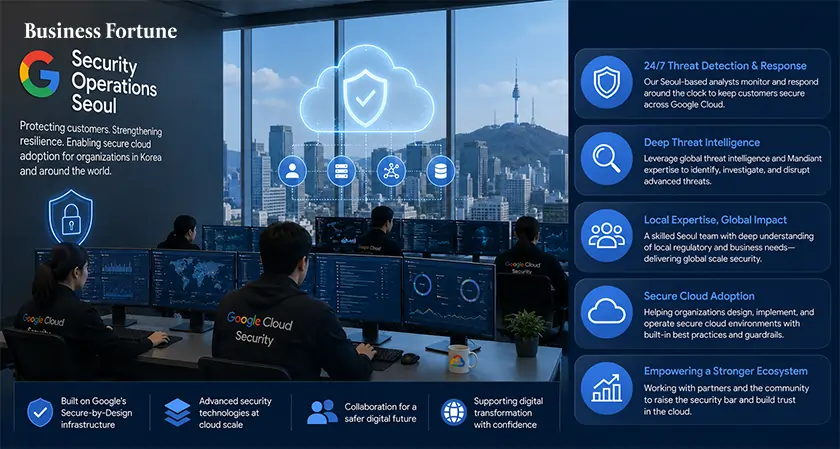
Google Security Operations Seoul now offers localized data residency, helping South Korean organizations strengthen cloud security while meeting compliance and data sovereignty requirements.
South Korean organizations now have a new way to strengthen cybersecurity while meeting strict data regulations. Google security operations Seoul has officially launched localized data residency within the Google Cloud Seoul Region, allowing businesses and government agencies to store and process security logs and analytics data inside South Korea.
The move is designed to help organizations comply with local data governance and residency requirements while taking advantage of Google's AI-powered security platform. As cyberattacks become more advanced, many organizations are looking for cloud-based security solutions that can provide faster threat detection without compromising regulatory compliance.
A Major Step for Data Sovereignty and Security
Google Security Operations combines Google's cloud infrastructure, threat intelligence capabilities, and artificial intelligence technologies to help security teams detect, investigate, and respond to cyber threats.
With the new Seoul-based deployment, organizations can keep sensitive security data within the country while benefiting from Google's advanced cybersecurity tools. This is particularly important for highly regulated sectors such as financial services and government institutions, where data residency requirements often influence technology decisions.
According to Google Cloud, the platform also provides sovereign controls for defensive AI systems, helping organizations maintain greater oversight of their security operations.
How Does AI Help Security Teams Work Faster?
One of the key features of the platform is its use of Google's Gemini AI models. These AI capabilities help automate threat detection and response processes, reducing the workload on security teams.
The platform enables organizations to:
-
Detect suspicious activity more quickly
-
Automate incident response workflows
-
Create security playbooks using drag-and-drop tools
-
Run multiple response actions simultaneously
-
Track and manage workflow versions
These features can help security teams respond to attacks faster and improve overall operational efficiency.
Financial Institutions Could Benefit the Most
The launch comes at a time when South Korea's financial sector is increasingly exploring AI-driven security solutions. Recent adjustments to network separation rules by the Financial Services Commission (FSC) have opened new opportunities for financial institutions to adopt cloud-based cybersecurity platforms for vulnerability management and security operations.
Jagdish Mahapatra, Managing Director of Google Cloud Security for JAPAC, described the launch as a significant milestone for Korea's cybersecurity landscape. He said the Seoul deployment brings Google's AI innovation and threat intelligence capabilities directly to Korean organizations while supporting local data sovereignty requirements.
Stronger Ecosystem Through Partnerships
Google Cloud is also expanding its collaboration with local partners, including Bespin Global, LG CNS, and Megazone Cloud. These partnerships aim to accelerate adoption of AI-powered security tools and help organizations build stronger cyber defense capabilities.
As Business Fortune observes, cyber threats continue to evolve and demand for AI-powered security solutions is expected to grow across South Korea. With localized data residency now available, more organizations in regulated industries may feel confident adopting cloud-based security operations. Google Cloud's partnerships and continued AI investments are likely to play a key role in expanding the platform's reach throughout the Korean market.
FAQs
What is Google Security Operations?
Google Security Operations is an AI-powered cybersecurity platform that helps organizations detect, investigate, and respond to cyber threats.
What does localized data residency mean?
It means security logs and related data can be stored and processed within South Korea rather than being transferred to another country.
Why is the Seoul deployment important?
It helps organizations meet local data sovereignty and compliance requirements while using advanced cloud security services.
How does Gemini AI support cybersecurity?
Gemini AI helps automate threat detection, incident investigation, and response workflows, allowing security teams to react more quickly to attacks.
Which industries are expected to benefit most?
Highly regulated sectors such as financial services, government agencies, and public institutions are expected to gain the most from the new deployment.


.webp)