Chinese startup Zenk Space raises $26 million, preparing Zhihang-1 kerolox rocket for June orbital launch attempt from Kourou French Guiana site
-
Zenk Space secures $26 million ahead launch
-
Zhihang-1 rocket planned for June orbital debut
-
Rocket uses YF-102 engines and kerolox fuel
-
Company pursues partial engine recovery and reuse system
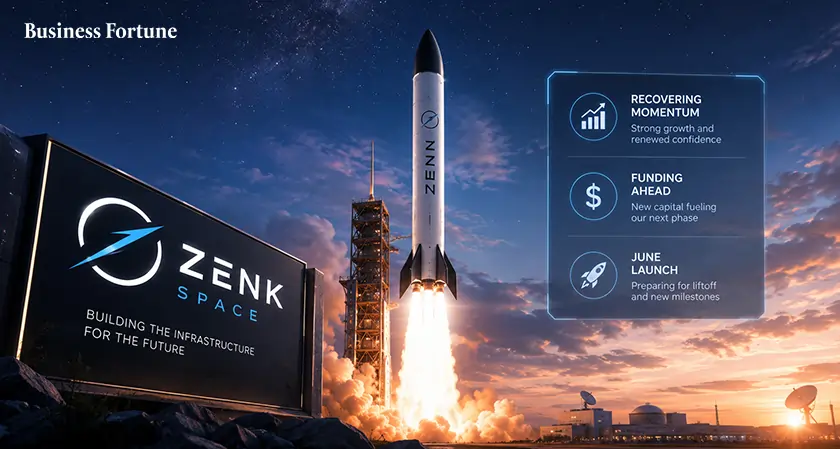
KOUROU, French Guiana: In preparation for the June launch of its Zhihang-1 kerolox rocket, which will be China’s first attempt at an orbital launch, Zenk Space recovering momentum has raised an additional 180 million yuan, or roughly $26 million, in financial funding. As the company works toward ultimate launch readiness from operations connected to its growing commercial space activities, a mix of private and state-backed investors participated in the round, which was led by Wenzhou Bay New Area Investment Group.
Funding momentum and launch preparations
Wenzhou Bay New Area Investment Group reportedly led the financing, with Yarong Ventures, Eastern New City Group, and Wenzhou Municipal State Investment Company participating. Pre-launch testing, logistics, and final integration work for Zhihang-1 are anticipated to be supported by the fund infusion. As it develops a vertically integrated supply chain for its launch system, the company, formerly known as Beijing Space Zhihang Technology Co., Ltd., has increased its production and research and development presence in Anhui province.
Zhihang-1 rocket and technical profile
The 49.8-meter Zhihang-1 kerosene-liquid oxygen rocket can transport up to 4,000 kg to a 500-kilometer sun-synchronous orbit. It makes use of YF-102 engines, which were created by the propulsion division of China Aerospace Science and Technology Corporation. CAS Space and Space Pioneer also employ this system. R-Space, a commercial partner, provides propellant tanks. After a successful static fire test earlier in the year off the coast of Shandong, China, the rocket was moved to a rehearsal site in mid-May.
Incremental reuse strategy and industry expansion
For the first stage of Zhihang-1, Zenk Space is also adopting an incremental recovery strategy, with a focus on Zenk Space recover rocket engines through engine bay recovery rather than full booster reuse. The section is designed with thermal protection to withstand reentry after separation, followed by parachute deployment and airbags enabling a controlled splashdown. Similar to partial recovery concepts explored globally, the recovered engines would then be inspected, repaired, and potentially reused in future missions.
China's commercial launch industry is still growing, with new clusters appearing in provinces like Anhui, Wuhan, and Guangzhou in addition to the renowned centers in Beijing, Shanghai, and Xi'an. In order to assist infrastructure development and industrial scale-up, local governments are increasingly utilizing investment vehicles to draw in aerospace companies. This larger, policy-based desire to create a competitive commercial space ecosystem across several areas is reflected in Zenk Space's ascent.
Industry context and upcoming launch significance
As Zenk Space looks to enter China's cutthroat commercial launch business, the June launch of Zhihang-1 is seen as a crucial turning point. Failure could impede investor momentum, while success would support its engine sourcing strategy, partial reuse method, and vertically integrated manufacturing model. As China's private space industry increases orbital launch efforts, the mission is also being closely monitored.
Thus, Business Fortune is of the view that Zenk Space’s recovery-focused strategy could reshape China’s commercial launch competitiveness if execution matches ambition and timelines.


.webp)