UK launches £3m UCL-led hub with LSE and IFS to analyse education economics and long-term policy impact outcomes.
-
DfE funds education research center in England initiative
-
New centre aims to reshape education policy thinking
-
Focus on evidence-based education and skills policymaking
-
Nearly £3 million allocated for research development project
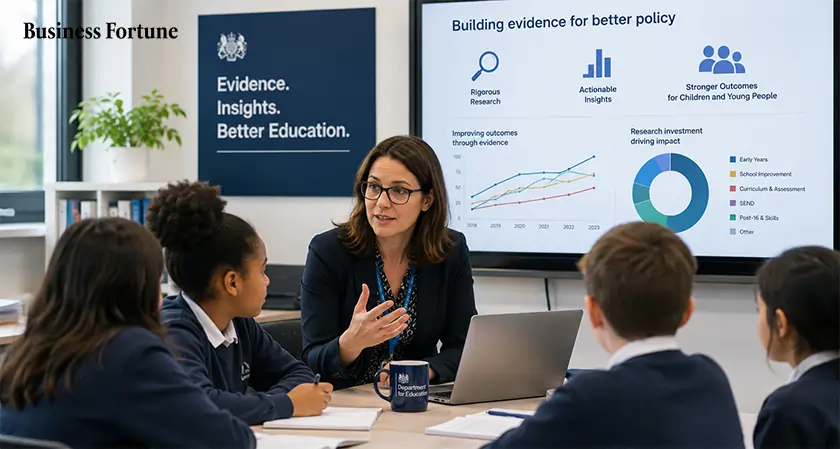
England’s Department for Education (DfE) has awarded a contract worth nearly £3 million, with DfE funds education research center in England, to establish a new Economics of Education Research Centre, with the aim of strengthening the evidence base for education and skills policymaking.
In partnership with University College London (UCL), the London School of Economics (LSE) and the Institute for Fiscal Studies (IFS), UCL Consultants Ltd. has been given the contract to lead the project. The center will be at the middle of advantages to better understand the long-term social and economic worth of education and is expected to stay open until March 2028.
The new research center will concentrate on creating instruments and data to assist government decision-making in a variety of policy domains. Early childhood education, post-16 paths, special educational needs and disabilities (SEND), skill development and the difficulties experienced by young people who are not in educational institutions, work or training (NEET) are a few of these.
The Department for Education claims that the center will assist in determining how investments in education affect public spending, financial incomes, productivity and social mobility. Also, it will investigate whether early intervention can lower long-term economic and social costs in sectors such as early childhood education and SEND services.
Analyzing extensive datasets, such as the Longitudinal Education Outcomes dataset and connected child health and education data systems, will be a key component of the center's work. To enhance the use of evidence in policymaking and bolster the department's own analytical capability, researchers will work closely with DfE analysts.
The institution will also emphasize partnership between academia and government. The program will be led by senior academics from UCL, LSE and IFS, with an emphasis on converting research into useful tools that policymakers may use when evaluating investment choices and educational improvements.
According to officials, the effort represents a larger change in the DfE's approach to research, shifting away from short-term commissioned studies and toward long-term relationships with universities. It follows the department's concurrent investment in an educational neuroscience research center, which aims to enhance the economics-focused hub by investigating children's learning and development.
According to Olivia Bailey, the minister of early education, the new centers will ensure that improvements in education are supported by solid data and practical results. The goal, according to her, is to make sure that SEND, early childhood and children's mental healthcare policies are based on a solid body of research.
Michael Thomas, DfE Chief Scientific Adviser, claims that the centers will bring together leading experts in neuroscience and economics, assisting the government in developing a stronger evidence base for decisions affecting children and youngsters.
Beyond research, the Economics of Education Research Centre will focus on developing future education economists and strengthening analytical capability in academia and government, placing itself as a long-term knowledge center for English education policy.
Thus, Business Fortune is of the view that the new research centre marks a significant step toward data-based education reform that could shape long-term policy decisions in England.


.webp)