National parties are rapidly expanding influence as regional forces struggle to retain voter trust and political relevance across Indian states.
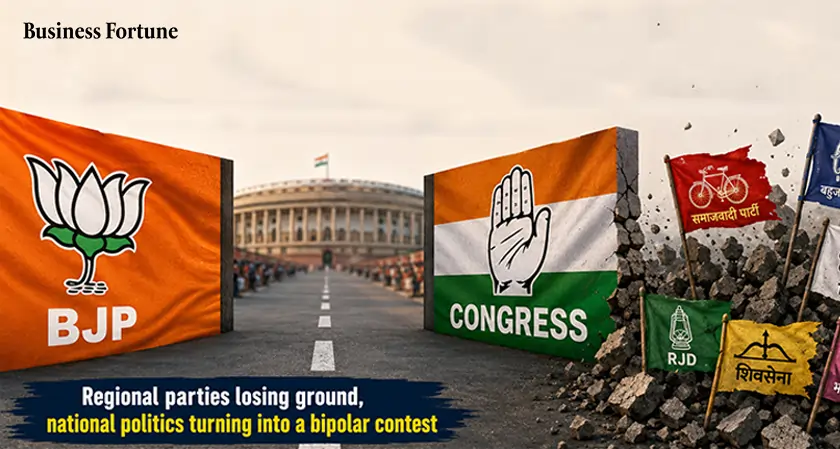
India's political environment is undergoing a big change as national parties like the BJP and Congress increase their influence while regional parties gradually lose it. The decline of regional parties in India has become increasingly visible as voters' preferences have clearly moved toward broader national agendas in recent state elections, especially in places that were controlled by strong national forces. Alliance politics in India may change as a result of this trend, according to political analysts.
BJP and Congress Expanding Their Influence
Over the past ten years, the Bharatiya Janata Party's ascent has extremely changed India's political environment. The BJP-run alliance currently controls the majority of Indian states and regions, expanding its power all over much of the nation, compared to just a few states in 2014. Despite being weaker across the nation than the BJP, the Congress has also grown stronger in multiple domains.
-
BJP and allies now govern territories covering nearly 72% of India’s population.
-
Congress secured important victories in states like Kerala.
-
National parties are increasingly dominating Assembly elections.
-
Voters appear to prefer strong national leadership over regional identities.
Regional Parties Losing Their Traditional Strongholds
Support for a number of regional parties that formerly formed coalition governments is currently waning. The increasing influence of national parties has caused political groups like the DMK, BJD, Shiv Sena sections and others to struggle.
-
West Bengal witnessed the BJP defeating the Trinamool Congress.
-
Odisha saw the decline of Naveen Patnaik’s long-standing BJD government.
-
Maharashtra’s regional parties have weakened due to internal splits.
-
Telangana’s BRS also lost power after years of dominance.
Shift in Voter Behavior and National Narratives
According to analysts, Indian voters are moving away from state-based political identities and toward wider national narratives. The BJP has been able to expand into areas that were previously thought to be impossible to penetrate because of its structured campaign approach and strong leadership image.
-
BJP’s “double-engine government” model has gained popularity.
-
National issues now influence state election outcomes more strongly.
-
Regional identity politics appears less effective than before.
-
A strong grassroots organization has increased the BJP’s electoral success.
Southern India Still Offers Resistance
Southern India is still one of the few areas where regional politics still have a large influence despite the country's change. But even there, national party pressure is gradually growing.
-
Tamil Nadu witnessed the emergence of Vijay’s TVK as a new force.
-
Kerala continues to resist BJP expansion.
-
Congress managed to defeat Left forces in Kerala.
-
Regional politics in the South remain influential but increasingly challenged.
Regional Parties Face Uncertain Future
National parties may not have the same power as they did during the alliance era between 1989 and 2014, but political experts say they are unlikely to totally vanish. Whether local forces successfully adjust or keep losing ground could be decided in the future.
-
Analysts say regional parties still retain strong local leadership.
-
Coalition politics may continue in selective states.
-
National parties are expected to dominate future elections.
-
India’s political system may become increasingly centralized.
Thus, Business Fortune is of the view that India’s political future will increasingly favor national dominance while regional influence steadily declines nationwide.


.webp)