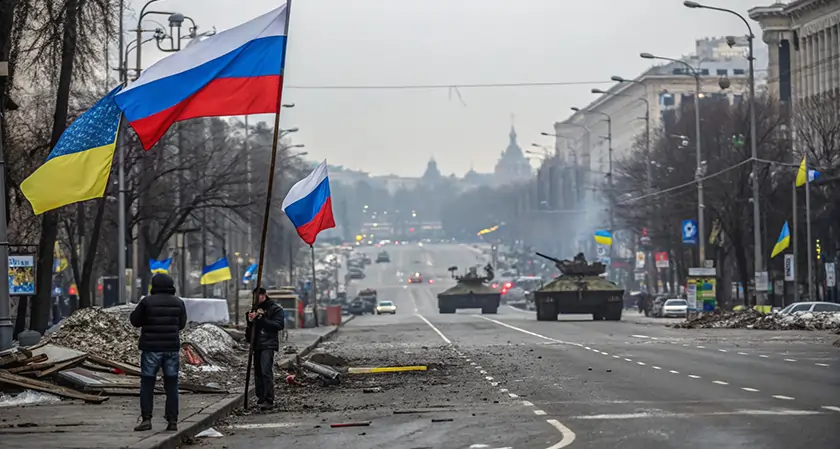
Russia’s war in Ukraine enters its fifth year and raises questions about Russia’s long-term power and strategic future.
Russia's invasion of Ukraine has already entered its fifth year. The Kremlin launched its full-scale invasion of Ukraine on February 24, 2022; four years later, Russia's conflict on Ukraine continues. It has lasted longer than Nazi Germany's horrific struggle against the Soviet Union, known as the Great Patriotic struggle.
It was largely perceived outside of Russia as an attempt to undermine the entire post-Cold War European security framework and push Kyiv back into Moscow's sphere of influence. The real Russian intentions are far more pragmatic and unprepared. They essentially amount to establishing a very clear red line against NATO's expansion towards Russia's frontiers, which was obviously intended to isolate and control Russia rather than envisioning the eventual incorporation of Russia itself.
Russian political elites are still confident that Vladimir Putin, their leader, did not make a serious mistake. They have strong cause to think that the battle is coming to a conclusion on their terms, possibly even in the near future, and they are looking back with a sense of accomplishment. Since February 2022, Russian troops have lost more soldiers than any significant nation in any conflict since World War II, with roughly 1.2 million casualties and up to 325,000 losses. By the spring of 2026, the total number of Russian and Ukrainian casualties could exceed 2 million at the current rate.
Listening to Russian President Vladimir Putin and even some U.S. policymakers sounds like Russia is marching to an inevitable battlefield victory in Ukraine. However, a detailed examination of the statistics reveals that Russia is rarely winning, and, more curiously, that Russia is becoming a losing power.
The war is also causing strain on Russia's economy, but it has not entirely collapsed. Inflation is still persistently high, consumer demand is waning, Russian manufacturing is shrinking, and the nation is experiencing a manpower shortage. In 2025, economic growth fell to 0.6 percent, and Russia is still lagging behind in important technologies like artificial intelligence.


.webp)