10 Smartest Companies of the Year 2025
Business Fortune
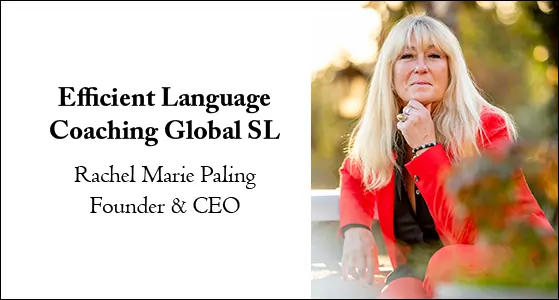
The ability to communicate across borders is no longer a luxury—it’s a necessity. In a globalized world where businesses expand across continents and professionals collaborate across time zones, mastering new languages shouldn’t be a slow, outdated process. It should be efficient, personalized, and aligned with how the brain naturally learns. That’s exactly what Efficient Language Coaching Global SL delivers—an innovative, science-fueled approach that is transforming language learning for businesses and individuals worldwide.
Efficient Language Coaching is redefining how languages are learned, replacing rigid, one-size-fits-all teaching by interweaving tailored coaching with neuroscience and emotional intelligence. With a network of over 1,700 certified Neurolanguage Coaches® across 74+ countries, the company ensures that professionals, executives, and organizations receive language training designed for real-world success.
Founded initially in Germany in 2008 by Rachel Paling, a pioneer in Neurolanguage Coaching®, Efficient Language Coaching Global began as a corporate and private language provider but quickly evolved into a global certification powerhouse. Its ELC Language Coaching Certification, launched in 2012, established a new industry standard by blending coaching methodologies with linguistic expertise. With the CCE accreditation from the International Coach Federation (ICF), as well as the CPD from the UK Standards Board, the company has made language learning more effective, and deeply engaging.
At Business Fortune, we had the privilege of interviewing Rachel Paling, CEO of Efficient Language Coaching Global SL. She shared insights into how her company is on a mission to make language coaching accessible and efficient for millions worldwide, transforming teachers to help clients reach higher language levels in the most effective and efficient way.
Interview Highlights
Q. What inspired you to start Efficient Language Coaching in 2008, and what changes have you seen in the company’s trajectory since then?
2008 seems like such a long time ago, and there have been so many changes along the way! It really is fascinating to look back over these years, and as Steve Jobs said, “to join the dots.” Right from being a teenager, I’ve had an entrepreneurial spirit, so setting up my own company was natural for me. In fact, I started teaching English when I was just 17, but little did I know that my company would be focused on language coaching! At the time of setting up, I had been a freelance Business and Legal English Language Coach across Europe, and I was at the point where I (alone) had a portfolio of approximately 50 clients and needed support from other language professionals to expand the business. By 2012, I was heading a team of 12 language trainers/coaches, and we were offering language services to corporates and multinationals, and we were extremely busy!
From 2012 onwards, I began dedicating focus and attention to the creation of my new approach, “Neurolanguage Coaching®.” This resulted from the culmination of my own personal development in life coaching, neuroscience/brain-based coaching, and weaving these into the language learning process. I conducted a pilot of my teacher training programme with my own team in 2012 and started rolling this programme out to the public in 2013. Now, 12 years later, there are just over 1,700 Neurolanguage Coaches in the world for all different languages and 30 teacher trainers delivering the training in 12 languages.
So, yes, the trajectory of the company shifted from 100% language coaching corporate clients to 75/25% delivering teacher training/language coaching clients.
In addition, the language learning panorama is changing rapidly with the onset of more and more AI. Personally, I think one of the first professions that will be hit hard by AI will be language teaching. It will require a certain type of educator who knows how to harness our humanness as well as complement AI. That is exactly the role of the Neurolanguage Coach!
Q. What sets Neurolanguage Coaching® apart from the more conventional approaches to linguistic learning?
The Neurolanguage Coaching® process is about getting learners to learn in a much more focused and potentially faster way, with a totally personalized roadmap that incorporates metacognition as to how the coachee learns the language better.
By transforming language educators, equipping them with the knowledge and tools to come into a professional coaching conversation that is “brain-friendly,” it totally transforms the learning.
In practical terms, we incorporate elements from professional coaching. Secondly, we incorporate and share knowledge about how we learn and how to optimize the learning according to neuroscience, neuropsychology, and emotional intelligence.
Thirdly, Neurolanguage Coaching® offers a new structured process for language learning with a distinctly hallmarked first session with a coachee, creating a personalized roadmap, based on mechanical and mastery goals and a unique conversation regarding motivation and commitment. Ongoing sessions are high-powered with full focus on learners’ goals and cost-effectiveness/achieving results so that learners feel their learning progress much more than they normally would. We also approach grammar through very calm, brain-friendly conversations that provoke major insights for learners. Lastly, learners are getting grammar instantly and implementing it with no issues whatsoever!
Q. How do you incorporate principles of neuroscience into your coaching techniques, and what specific advantages do these methods provide for language learners in terms of efficiency and retention?
We implement neuroscientific principles relating to how the brain learns, with particular attention to the activation of the sympathetic nervous system and the activation of the hypothalamic-pituitary-adrenal axis. Any learner in the “fight or flight” state is not in the “optimal learning state” and cannot learn! So, we infuse the process with a lot of self-awareness (metacognition), emotional intelligence, and neuropsychology. One of our greatest challenges as educators is how to embody and implement the theory in practical terms. Also, how to bring this information across in a simplistic way that makes complicated scientific jargon easily understandable for all teachers, educators, and learners. We adapt the process to reflect the research, and everything we do has a reason and justification behind it. For example, getting learners to set their own goals based on self-determination theory and self-actualization or chunking down the grammar or the functional language to bring in more certainty.
The coach opportunely shares information about how the brain learns, reacts, and functions with the learners, in easily comprehensible language according to the level and age of the learner, and through our constant awareness of the power of words and patterns of communication.
Q. With a network spanning over 74 countries, how does ELC ensure consistency and quality across diverse cultural and linguistic landscapes?
As a training academy, we offer our courses across the globe and to all language educators. Many of these teach other languages and not only English. The beauty of Neurolanguage Coaching® is that it offers a framework and structure for these teachers to adapt to any language and any culture. The teachers themselves are the experts in that language and culture. Our courses offer them a totally different and more efficient way to deliver their expertise.
Q. What role does ELC’s CPD Registered Provider status and ICF accreditation play, and how do they impact your clients?
Right from the beginning, I was very clear that accreditation and certification were important for language coaching. In 2012, language coaching was not even heard of, so as a pioneer in this field, I understood the importance of ensuring that our courses brought professional standards. This is the reason we applied for the ICF accreditation right from the start. In addition, we added the CPD status to bring in even more professional credibility.
Q. Could you give some instances of how the customized coaching provided by ELC has improved the language proficiency and career outcomes of its clients?
One of the major problems for many business professionals today is the need for more advanced language skills, and often there is no time to learn, or due to heavy workloads, there is a lot of stress and anxiety around language learning. Through the years, many of our coaches have boosted learning. One of our Italian coaches helped a learner to achieve a certain level in Japanese in three months, that would have taken one year at university! Another coach worked with one lady to overcome her fear of contributing at business meetings, and after two sessions with the coach, the client implemented strategies and amazed everyone at work by actively speaking up with no fear whatsoever! I have also witnessed how one learner finally understood a grammar point that she had been grappling with for twenty years – in one session consisting of a 30-minute coaching conversation, she declared, “WOW, I have finally got it!”. Countless examples! For me, the greatest gift is hearing the feedback from the clients of our neurolanguage coaches!
Q. How do you envision ELC and the language coaching industry developing in the future, especially in light of emerging technologies and the demands for global communication?
I do believe that we are embarking on a new era in education. My research is very focused on post-pandemic trauma and how teaching has changed, but even more, how our learners have changed. When we add the emerging technologies, machine learning, AI tutors, etc., we are definitely at a turning point. We could even say that language teachers are one of the most endangered professions. Personally, I believe that all teachers would need to be trained on how to implement the neuro aspect, emotional intelligence, and incorporate coaching conversations and brain-friendly communication into their everyday work. It is necessary to step up on our humanness. In fact, ideally, language learning would be the perfect balance of the learner working with AI tools and chatbot-assisted language learning together with the human language coach who emotionally supports and helps structure and adapt the learning to that individual.
Q. What exciting plans or new initiatives does ELC have in the pipeline, and how do you envision them shaping the future of language learning?
We have a parallel course to Neurolanguage Coaching called Neuroheart Educational Coaching. This is for any teacher (non-language). The focus is to bring professional coaching and the neuro aspect to all teachers. Obviously, they are the experts in their topics, and we are bringing that different approach and style of delivery that adapts more to the learners of today. In many ways, this new approach also helps teachers manage neurodiversity, cope with stressful situations, and stimulate learner autonomy and learner ownership.
We also set up the Neuroheart Education Foundation to support teachers and learners with training courses that bring more coaching, neuroscience, and well-being and assist this transition into a new approach to education.
The Stalwart Leader Upfront
Rachel Marie Paling is the Founder and CEO of Efficient Language Coaching and creator of Neurolanguage Coaching® and Neuroheart Education®. With over 38 years of experience in teaching English, Rachel holds a BA in Law and Spanish (UK), a Master’s in Human Rights and Democratization from the University of Padua (Italy) and Ruhr-Universität Bochum (Germany), and a UK lawyer qualification. Instead of pursuing law, she combined her teaching expertise and legal background to coach executives across Europe. From 2003 to 2011, she developed as a life and language coach and, in 2012, created Neurolanguage Coaching®. She began training teachers with one of the first ICF CCE-accredited programs for language teachers, having since trained over 1,700 teachers worldwide.
In 2020, she co-founded the Neuroheart Education Foundation with ELC and Gary Houlton to transform education globally, offering a CCE-accredited course for teachers across disciplines. Rachel is an ICF PCC credentialed coach, a registered ICF Coach Mentor, and a certified Coach Supervisor. She holds an MA in Applied Neuroscience and a Master’s in Neuroeducation and Neuropsychology and is currently pursuing a DBA at the Weatherhead School of Management, Case Western Reserve University, Cleveland, Ohio.


.webp)