Business Fortune
In an era where data is king, Civitas Learning stands out as a revolutionary force in higher education. This Austin-based company has emerged as a game-changer, harnessing the power of data to help colleges and universities unlock new levels of student success and institutional efficiency. Civitas Learning's innovative approach has not only captured the attention of educators and administrators across the globe but also positioned it as a leader in the burgeoning field of educational technology. Founded in 2011 by Charles Thornburgh, a former executive at Kaplan, Civitas Learning was born out of a vision to harness the vast amounts of data generated by higher education institutions to improve student outcomes.
Thornburgh, along with co-founder Mark Milliron, an educator and administrator with deep experience in higher education, saw an opportunity to leverage technology in a way that was never done before in the academic arena.
The Civitas Approach
At its core, Civitas Learning is a cloud-based platform that collects and analyzes data from various sources within a higher education institution. This includes data from learning management systems, student information systems, and other digital tools used by students and faculty. The platform employs advanced analytics and machine learning to glean insights that can inform decision-making at both the student and institutional levels.
One of the most significant contributions of Civitas Learning is its impact on student success. By analyzing data patterns, the platform can identify students who are at risk of dropping out or failing courses. This enables institutions to intervene early with targeted support, dramatically improving retention and graduation rates.
For example, at the University of Central Florida, the implementation of Civitas Learning's platform led to a noticeable increase in student retention. The university leveraged data insights to tailor its advising services, resulting in more effective support for students who needed it the most.
Driving Institutional Efficiency
Beyond student success, Civitas Learning also aids in enhancing institutional efficiency. The insights provided by its platform help colleges and universities optimize resource allocation, improve curriculum planning, and make informed decisions about program development. This not only leads to better educational outcomes but also ensures financial sustainability for institutions in an increasingly competitive landscape.
Civitas Learning's success has not gone unnoticed. The company has expanded rapidly, partnering with over 350 colleges and universities worldwide. These partnerships are not just limited to data analysis; Civitas also works closely with institutions to implement changes based on data insights, ensuring that the information leads to actionable strategies. Despite its success, Civitas Learning has not been without its challenges. Concerns around data privacy and the ethical use of student information have been raised. Thornburgh has addressed these concerns head-on, ensuring that data is used responsibly and with the utmost respect for student privacy.
Moreover, the reliance on big data in education has sparked a broader debate about the role of technology in academic settings. Critics argue that data-driven approaches may oversimplify the complexities of education and student experiences. Civitas Learning, however, maintains that their platform is a tool to enhance, not replace, the human element in education.
Future Prospects
Looking ahead, Civitas Learning is poised for continued growth. With the increasing focus on personalized learning and outcome-based education, the demand for data-driven solutions is likely to rise. Civitas's ability to adapt and evolve with changing educational trends will be crucial to its ongoing success. Additionally, the company is exploring new frontiers in education technology. This includes the potential integration of artificial intelligence and predictive analytics to further refine its offerings and provide more nuanced insights into the learning process. Civitas Learning stands at the forefront of a transformative movement in higher education. By harnessing the power of data, it is helping institutions navigate the complex landscape of modern education. Its impact on student success and institutional efficiency is a testament to the potential of technology to not only enhance learning but also to reshape the future of education.
As Civitas Learning continues to innovate and expand its reach, it serves as a beacon for how data and technology can be used responsibly and effectively to elevate the educational experience for all. In a world where data is increasingly becoming a central part of every industry, Civitas Learning is leading by example, showing how data, when used wisely, can be a powerful tool for positive change in higher education.
Meet the leader behind the success of Civitas
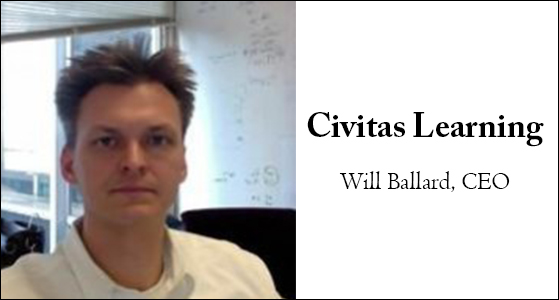
Will Ballard, Chief Executive Officer
An accomplished technology company executive and engineering leader who first joined Civitas Learning as chief technology officer in 2020, Will has more than twenty years of experience managing large technical and engineering and teams and supporting customer success for enterprise technology customers.


.webp)