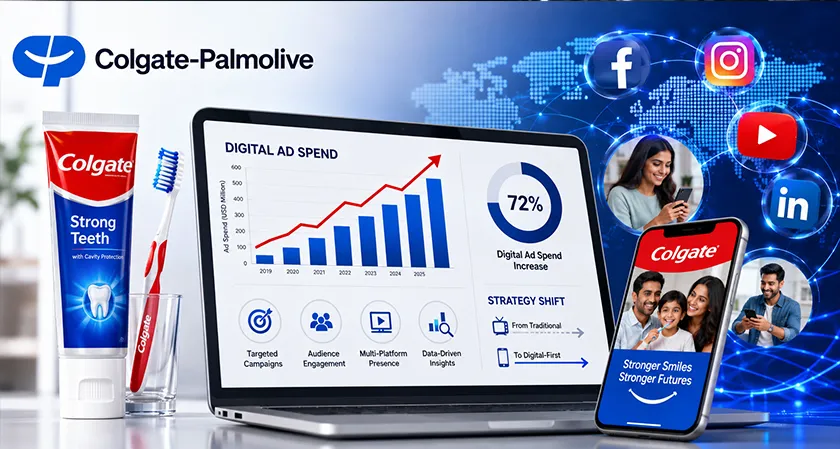
Colgate-Palmolive is shifting its marketing strategy toward digital advertising, premium brands, influencers, and social media as television reach declines.
Colgate-Palmolive India is transforming its approach to marketing in light of shifting consumer behavior patterns that drive people online, with spending on Colgate digital advertising spend for about 60% of the company’s media budget. Moreover, the company is increasing the level of expenditures on A&P, which makes up 15.8% of the sales volume.
Digital takes centre stage as TV reach weakens
According to Managing Director & CEO Prabha Narasimhan, Colgate is experiencing a sharp fall in viewership of the television channel all down the income hierarchy. The mobile access has been pushing the poorer segment to digital media, while the richer ones prefer channels without advertisements. It was stated that about 60% of Colgate's advertising expenditure goes to digital channels, while the rest goes into television.
Premiumisation drives higher brand investment
Colgate’s digital advertising strategy is closely linked to its premiumisation push. A&P spending has increased from the historical 12-13% of sales range to nearly 16%, reflecting greater investment behind brands.
The premium portfolio has an A&P-to-sales ratio of about 50-60%, applying specifically to the premium business rather than Colgate’s overall advertising budget. Management said the premium segment is growing around six times faster than core brands, while its contribution to toothpaste sales has risen 2.5 times.
Campaigns move beyond traditional TV commercials
Colgate is changing how it develops advertising. Rather than relying on one television commercial for months, the company is adapting a central idea into multiple formats across influencers, key opinion leaders, social media and brand communication. For Colgate Total, sports provide the campaign platform, while Visible White is linked to beauty experts. The objective is stronger cultural connections.
Key takeaways
-
Digital now receives roughly 60% of Colgate’s media spend.
-
Television remains important for middle-income consumer reach.
-
A&P spending reached 15.8% of sales in Q1.
-
Premium brands are growing six times faster than core.
-
Colgate is expanding influencer-led and social media campaigns.
The shift reflects a broader change in Colgate marketing strategy, with media allocation shaped by consumer behaviour and platform engagement. E-commerce and quick commerce are also becoming important channels for premium products.
Management indicated that stronger margins are creating room to reinvest in advertising and premium growth. The strategy combines digital media investment, selective television use and specialised brand communication as Colgate seeks faster growth.
Business Fortune believes that Colgate’s growing digital focus, supported by premiumisation and targeted brand investments, will remain central to its strategy for sustaining growth as consumer media habits continue to evolve.
FAQs
What percentage of Colgate-Palmolive India’s media budget goes to digital advertising?
Around 60% of Colgate-Palmolive India’s media spending is allocated to digital advertising, reflecting changing consumer media habits.
Why is Colgate reducing its reliance on television advertising?
Colgate has observed declining television viewership across income groups, as lower-income consumers increasingly use mobile and digital platforms while higher-income consumers shift toward ad-free content.
How much does Colgate spend on advertising and promotion?
Colgate’s advertising and promotion spending reached about 15.8% of sales in Q1, up from its historical range of around 12% to 13%.
How is premiumisation affecting Colgate’s marketing strategy?
Premium brands are receiving greater marketing investment because the premium segment is growing around six times faster than core brands and has significantly increased its contribution to toothpaste sales.
Which digital channels is Colgate using to strengthen its campaigns?
Colgate is expanding beyond traditional television commercials by using influencers, key opinion leaders, social media and other digital formats to build stronger connections with consumers.


.webp)






























Comments