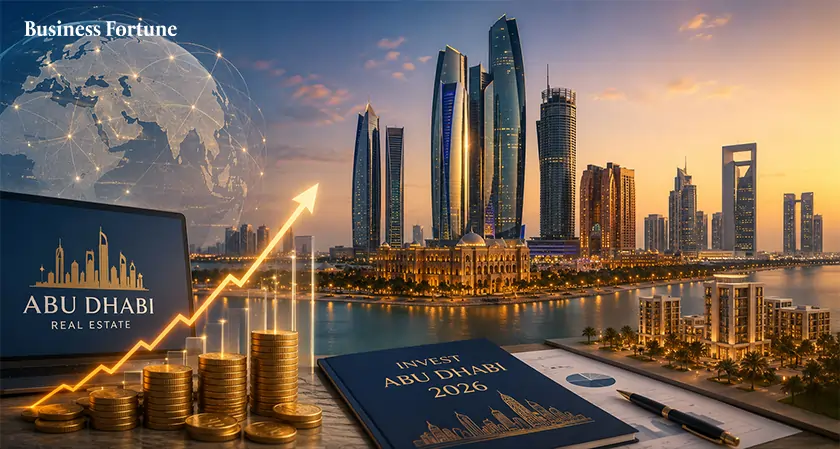
Why are investors from 116 countries buying into Abu Dhabi real estate? The latest market figures reveal a surprising growth story.
The Abu Dhabi real estate market saw remarkable growth in the first half of 2026, with total property transactions more than doubling compared to the same period last year. According to data released by the Abu Dhabi Real Estate Centre (ADREC), real estate transactions reached AED117 billion that is $32 billion between January and June.
The number of transactions also climbed significantly to 25,714 deals. The strong performance highlights Abu Dhabi’s growing appeal as a major global destination for property investment and long-term wealth creation.
Property Sales and Record Breaking Growth
Property sales emerged as the biggest contributor to the market’s expansion. Sales transactions reached AED86.1 billion across 16,838 deals, representing a massive 163.7% increase in value compared to the first half of 2025.
Mortgage activity also remained healthy, with transactions totaling AED26.7 billion through 8,876 deals. Meanwhile, musataha agreements, long-term leases and gift transactions contributed nearly AED4.3 billion to the overall market activity. The figures suggest strong demand from both end-users and investors, supported by a growing supply of new developments across the emirate.
Why Are International Investors Choosing Abu Dhabi?
One of the most notable highlights was the sharp rise in foreign direct investment (FDI). International investment in Abu Dhabi’s property sector jumped 309% year-on-year to AED13.8 billion during the first six months of 2026. Impressively, this amount surpassed the total foreign investment recorded during the whole of 2025.
Investors from 116 nationalities purchased properties in Abu Dhabi during the period, up from 82 nationalities a year earlier. The UK, China, Russia, the US, Germany, and France were among the leading contributors to foreign investment.
Investment zones open to buyers of all nationalities attracted AED75 billion in transactions, reflecting a strong 181% increase from the previous year.
Transparency and New Opportunities
Speaking about the market's performance, ADREC Director-General Rashed Al Omaira said, “Investment decisions begin with a clear understanding of the market, its direction and the rules that govern it.” He emphasized that transparent regulations and reliable market data are helping investors make informed long-term decisions.
To support future growth, ADREC approved eight new investment zones, increasing the total to 50 across Abu Dhabi. The regulator also registered 28 new real estate projects, up 16% year-on-year, creating fresh opportunities for local and international investors.
In addition, 2,040 new licenses were issued for real estate professionals, bringing the number of licensed brokers in the emirate to 3,302.
Digital Transformation
ADREC has also been strengthening transparency through digital initiatives. Its Madhmoun platform has issued more than 41,200 permits for real estate advertisements since launch, helping improve the accuracy and credibility of property information available to buyers and investors.
As Business Fortune sees the rising foreign participation, expanding investment zones, and continued regulatory improvements, Abu Dhabi’s property sector appears well-positioned for sustained growth. If current trends continue, the emirate could further strengthen its status as one of the world's most attractive real estate investment destinations in the years ahead.
FAQs
How much were Abu Dhabi real estate transactions worth in H1 2026?
Real estate transactions reached AED117 billion during the first six months of 2026.
How much did property sales increase in Abu Dhabi?
Property sales rose to AED86.1 billion, recording a 163.7% increase compared to the same period in 2025.
What was the value of foreign investment in Abu Dhabi real estate?
Foreign direct investment reached AED13.8 billion in H1 2026, up 309% year-on-year.
Which countries contributed most to foreign investment?
Major investment sources included the United Kingdom, China, Russia, the United States, Germany, and France.
What steps is ADREC taking to support market growth?
ADREC has approved new investment zones, registered new projects, expanded professional licensing, and enhanced transparency through digital platforms such as Madhmoun.


.webp)





















Comments