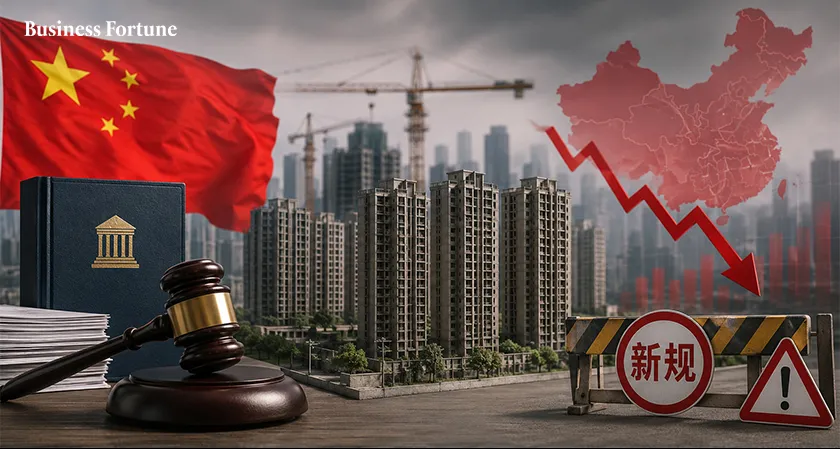
China is tightening its housing rules to protect buyers from unfinished homes. But the move could leave developers with less cash, fewer projects and a much tougher road ahead.
China’s property market is going through another big change. Under the new China property rules, developers will have to wait longer to use buyers’ mortgage money until their homes are completed. The move is part of Beijing’s effort to bring stability to a housing market that has been struggling for years.
The plan sounds straightforward: finish the homes first, then get access to the money. But that could be a tough shift for developers who have long relied on selling homes before they are built to fund construction.
The old way of selling homes is under pressure
For years, Chinese developers sold apartments long before they were ready. Buyers paid upfront, developers got access to the money and construction continued. That model worked during the property boom but now it has ended. After authorities cracked down on excessive borrowing in 2020, heavily indebted developers began running into trouble. Some projects stalled, leaving buyers stuck with homes that existed only on blueprints.
Now regulators want to make sure that does not happen again. Local governments have been told to push sales of completed homes, while buyers purchasing unfinished properties are set to receive stronger protection.
But what does this mean for developers?
Developers will have to wait longer for some of the money that keeps construction going. Under the new rules, mortgage funds and down payments would be released only once residential projects are fully completed. Earlier, developers could access the money after reaching the structural topping-out stage.
One private developer said the final stretch can take six to 12 months.“That will substantially delay fund disbursements and weigh heavily on our cash flow,” the developer said.
And the numbers show just how important this money is. Between January and July, deposits, advance receipts and mortgage proceeds accounted for 44.6% of developers’ total funding.
Buyers get more time
There is some good news for homebuyers. Regulators have raised the maximum mortgage term from 30 years to 40 years. That means buyers can spread repayments over a longer period, potentially reducing their monthly burden.
“These policies are a meaningful step in the right direction,” said Zhiwei Zhang, president and chief economist at Pinpoint Asset Management.
However, even a longer loan period may not be enough to persuade consumers to invest while their confidence in the real estate market remains low. Investors did not hang around waiting to see how the situation would unfold. Real estate shares plunged, China Jinmao, Yuexiu Property, and Greentown China being some of the worst affected.
Analysts expect the rules to push weaker developers out of the market and give stronger state-backed companies even more room to grow. China’s property pain is already visible in the numbers. Property investment fell 19.2% year on year to 4.3 trillion yuan in the first seven months of 2026, while government land-sale revenue dropped 30.8%.
China is betting on a very different property market
The immediate consequences can be painful. Developers will have less money, construction projects can stall and small firms may not survive.
However, Beijing seems prepared to tolerate such pain in favor of an eventual goal of creating a housing market in which consumers feel more confident that their purchased property will actually be delivered.
As Business Fortune observes, this will not be an immediate change but if the reforms prove successful, then it may result in the Chinese property market moving away from speculative and presale models to completed houses and conservative growth.
FAQs
What are the new China property rules about?
They aim to reduce developers’ dependence on buyers’ money before homes are completed and provide greater protection to homebuyers.
Why are developers worried?
They may have to wait longer to receive mortgage and down-payment funds, putting pressure on their cash flow.
What changed for home loans?
The maximum personal housing loan term has been extended from 30 years to 40 years.
Will these rules solve China’s property crisis?
They may improve buyer confidence and reduce delivery risks, but weak demand and falling investment remain major challenges.
What could happen to property developers?
Stronger developers, particularly well-funded state-backed companies, could gain market share while highly leveraged and smaller private developers may struggle or leave the market.


.webp)































Comments