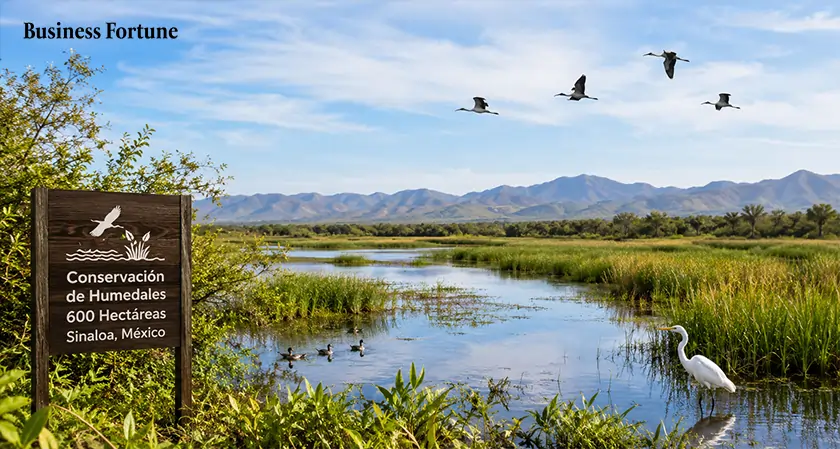
A new plan in Sinaloa is set to protect 600 hectares of wetlands through a joint effort between industry and Mexico’s forestry authority, helping protect mangroves and other fragile ecosystems while also creating local economic benefits.
A fresh conservation push is underway in Mexico’s Sinaloa state. Transition Industries LLC and Mexico’s forestry authority have signed a new agreement to protect 600 hectares in Sinaloa, strengthening both biodiversity and local livelihoods as industrial development expands in the region. Under this agreement, Transition Industries LLC and Comisión Nacional Forestal (CONAFOR) will safeguard 600 hectares of wetlands under the Pacifico Mexinol sustainability program. The move is part of a broader Environmental Services Payment (ESP) system designed to reward conservation work with structured funding.
Why are wetlands suddenly at the center of industrial planning
Wetlands in Sinaloa are not just patches of water and vegetation. They are natural systems that store carbon, reduce flooding risks, and support rich biodiversity. Despite no direct environmental impact from the Pacifico Mexinol project, the companies are aiming for what they call “biodiversity net gain,” meaning they want to restore and protect more nature than the project affects. Pacifico Mexinol project has committed to protecting an area nearly 100 times larger than what was originally required under environmental rules.
Key details of the conservation agreement
-
Protection area: 600 hectares of wetlands in Sinaloa
-
Funding model: 50% funded by Pacifico Mexinol and 50% by CONAFOR
-
Community role: Ejido Plan de Guadalupe residents will lead on-ground conservation
-
Focus ecosystems: Mangroves and Sarcocaule Scrub, vital for climate balance and flood control
-
Support system: Technical assistance and annual financial support through ESP program
This structure ensures that conservation is not just a policy goal but an ongoing, funded activity tied directly to community participation.
What does this mean for local communities
The agreement aims at social responsibility by directly benefiting rural communities, especially Ejido Plan de Guadalupe. Residents will receive financial support to carry out conservation activities while also gaining training and technical guidance. Instead of restricting local involvement, the program turns communities into active partners in protecting forests, mangroves, and arid ecosystems.
According to Pacifico Mexinol’s environmental team, the goal is to prove that industrial growth and environmental protection can move in the same direction when properly structured. The ESP model used by CONAFOR is already active across Mexico, supporting thousands of community-led conservation projects. Most of these are run through ejidos and rural landowners, showing a long-standing framework for shared environmental responsibility.
A broader sustainability strategy
This wetland protection deal is only one part of a larger plan. Pacifico Mexinol also includes wastewater reuse systems, renewable electricity sourcing, and a dedicated 15-hectare conservation buffer zone near the Bay of Ohuira. The project itself is a large-scale methanol facility designed with net-zero ambitions, expected to generate thousands of jobs during construction and operations while relying on cleaner technologies and circular water systems.
As Business Fortune observes, the success of this agreement could influence how future industrial projects in Latin America approach environmental responsibility. If the model proves effective, more developments may adopt similar shared funding and community-led conservation systems. For Sinaloa’s wetlands, the next few years will show whether economic growth and ecosystem protection can truly scale together.


.webp)