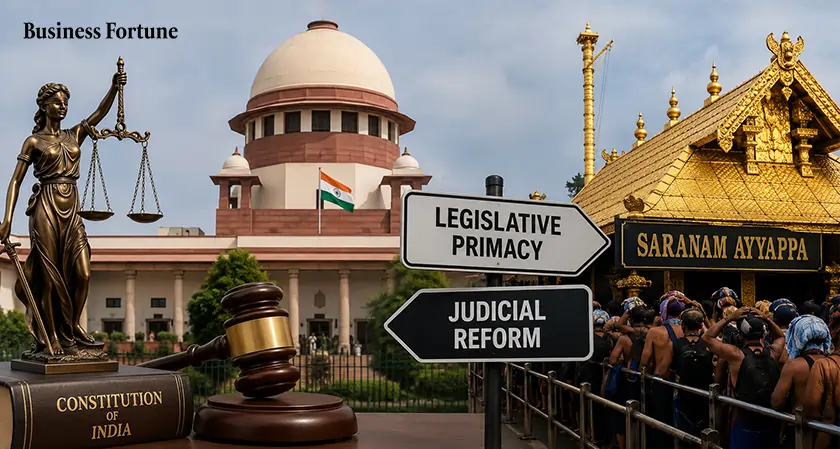
Centre argues reform lies with legislature, not courts, as Supreme Court examines Sabarimala case judgement amid constitutional interpretation debate.
-
The Supreme Court was informed by the Center that the Constitution does not envision courts acting as a secular reform authority over religious traditions; instead, the legislature and democratic process should be the primary means of reform.
-
Solicitor General Tushar Mehta claims that Article 25(2)(b) grants the government control over social and religious reform, ensuring that in a democracy, changes reflect the will of the people.
-
He warned that judicially focused reform of religious practices could open all traditions to legal challenges, with the Sabarimala case named as a key example.
-
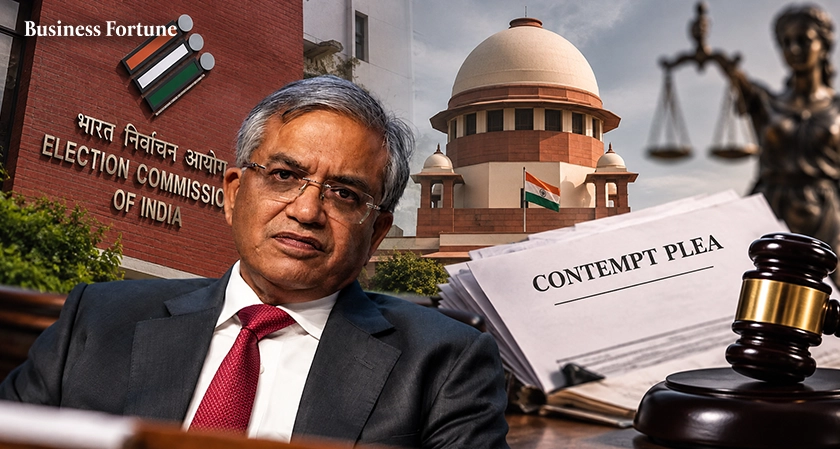
A nine-judge Constitution Bench led by Chief Justice of India Surya Kant is hearing the review of the 2018 Sabarimala judgment allowing women entry into the temple.
-
Judges on the bench raised concerns about balancing democratic making decision with legal limits, including risks of majoritarian effect in matters of religious belief.
The Center claimed that the legislative and political processes should be in charge of such change, reminding the Supreme Court on Wednesday that the Constitution forbids judges from acting as a secular reform authority over religious traditions. In front of a nine-judge Constitution Bench that was investigating issues related to the 2018 decision permitting women to attend the Sabarimala temple in Kerala, the request was made during the Sabarimala hearing.
Solicitor General Tushar Mehta argued on behalf of the Center that Article 25(2)(b) grants legislative authority over social and religious reform, guaranteeing that such modifications reflect the desires of the populace in a constitutional democracy. He advised that judicially enforced changes to religious belief would expose all customs and institutions to constitutional challenges, as seen in the Sabarimala case, resulting in a state where courts would have to decide conflicts concerning religious beliefs in daily life.
The nine-judge bench, which is supervised by Chief Justice of India Surya Kant and includes Justices B V Nagarathna, M M Sundresh, Ahsanuddin Amanullah, Aravind Kumar, A G Masih, Prasanna B Varale, R Mahadevan and Joymalya Bagchi, is considering petitions looking for a review of the 2018 Sabarimala temple case verdict. During the hearing, judges mindfully studied the center's opinions and a number of them stated concerns about how to strike a balance between democratic will and legal limitations on religious activity.
Mehta also emphasized that although courts shouldn't try to change religion on their own, they may step in where a law or practice goes against public health, morality, or order in Sabarimala case judgement. He claimed in front of the bench that Article 25 achieves a balance between limited governmental involvement and religious freedom through legislation rather than through judicial intervention.
Thus, Business Fortune is of the view that judicial restraint and legislative primacy remain central to resolving sensitive religious disputes.


.webp)