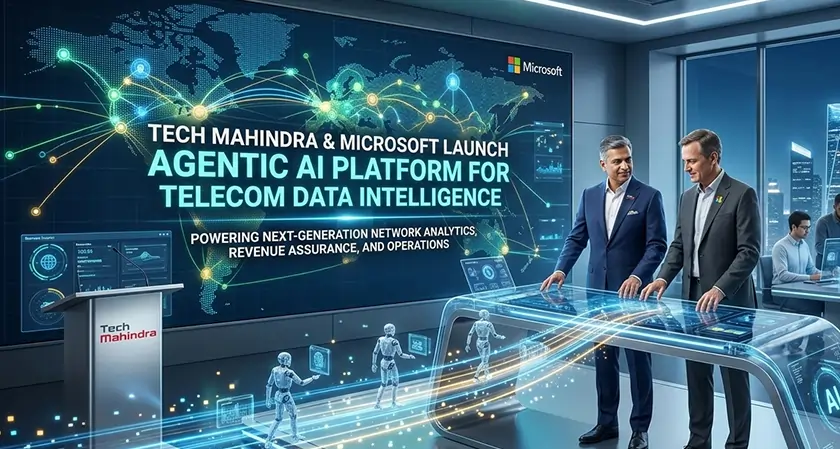
Tech Mahindra partners with Microsoft to launch an ontology-driven agentic AI platform that accelerates telecom and enterprise data modernization.
Tech Mahindra, a leading global provider of technology consulting and digital solutions for enterprises across industries, has announced a partnership with Microsoft to develop an ontology-driven Agentic AI platform that speeds telecom and enterprise data transformation. Built on Microsoft Fabric, a SaaS data analytics platform, and Azure AI Foundry, the solution allows explainable, auditable, and real-time AI-powered decision-making, as well as secure, regulated AI agent deployment.
The gap between enterprise information and actionable intelligence keeps widening as telecom operators and businesses develop through mergers and acquisitions and manage more complicated data ecosystems. By converting enterprise metadata into structured, reusable data products, Tech Mahindra and Microsoft will work together to overcome this obstacle and accelerate the adoption of data meshes from strategy to implementation.
Amol Phadke, Chief Transformation Officer, Tech Mahindra, said that telecom operators are moving beyond AI experimentation toward scalable intelligence that delivers measurable business outcomes. He also added that their ontology-driven agentic AI platform, developed with Microsoft, provides a governed semantic foundation for explainable insights, real-time decisioning, and cross-domain intelligence.
According to Monte Hong, Global Director of Microsoft's Telecommunications Industry Strategy, intelligence and trust are essential for telecom companies to secure the benefits of scaled AI. Microsoft IQ, which is based on Work IQ, Fabric IQ, and Foundry IQ, links AI, data, and business context, providing AI agents with a thorough understanding of operations, decision-making, and customer interactions.
The agentic AI platform allows real-time monitoring, reasoning, and recommendations across important telecom use cases like revenue assurance, fraud detection, network optimization, and churn prediction through multi-agent orchestration.


.webp)