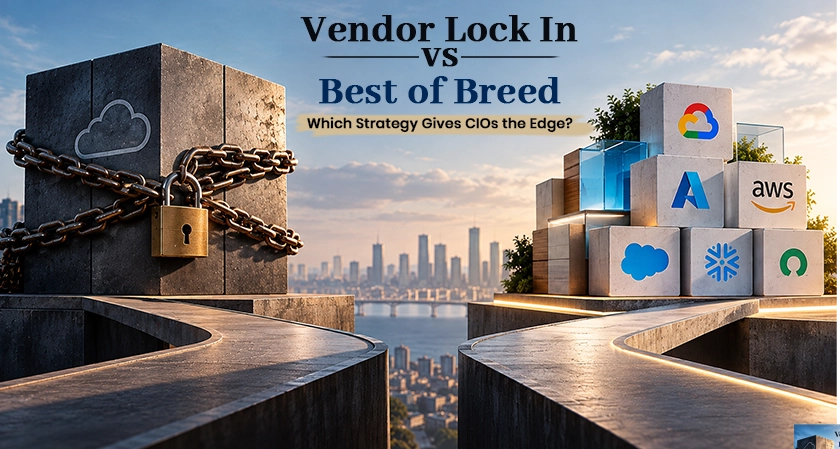
CIOs face hidden costs, flexibility tradeoffs, and technology dependencies that could shape enterprise resilience, innovation, and long-term competitive advantage.
The debate around vendor lock in vs best of breed is becoming harder for CIOs as enterprises try to control technology costs while still moving quickly. There is the possibility of streamlining processes for contract negotiation, integration, security and support when using a single provider. The over-reliance on a sole vendor could cause challenges with the issue of price, changing roadmaps and better competitor appearing. On the other hand, the use of specialized tools will provide greater functionalities at the expense of higher integration and vendors.
This is based on whether standardization will give added value or specialization will create competitive advantage. Integration and governance may come easily through suite applications, but functionality and flexibility might be greater with best-of-breed applications. Portability and exit strategy, in addition to proprietary and switching costs, are now being taken into consideration.
For CIOs researching the matter, Business Fortune looks into the distinctions between the two approaches, the vendor lock-in risks enterprises need to be aware of and the queries that they need to pose prior to their decision.
What is vendor lock-in and why does it matter to CIOs?
Vendor lock-in occurs in a situation where the organization has become so reliant on the technology provider that switching to another supplier becomes challenging, costly and complicated. The reliance is usually due to the data format, the interface, long-term contracts, migration costs, or the applications developed based on the vendor’s offerings.
Lock-in can reduce the ability to bargain and limit the options available to react to changing business requirements. The provider could modify pricing, end the availability of a product, change roadmaps, or fall behind their competition. If the cost of switching is high, the company has no other option.
However, lock-in is not necessarily something to shy away from. A proprietary technology might well be worth it for the organization if it provides them with a valuable business opportunity, which cannot be matched by any other means. As AWS suggests, some cloud-native technologies might actually justify sacrifices of portability as long as they provide value for money.
What are vendor lock-in risks for modern enterprises?
Vendor lock-in threats come in many forms and not necessarily only through technical reliance. Financial risks may increase due to contract agreements including minimum obligations, incremental fees based on usage, or prohibitive exit costs. The risk of operational dependence is when an organization relies on vendor skills and processes.
There is also an innovation risk. If the company is heavily dependent on architecture developed by only one supplier, moving to a more advanced service provided by another vendor may entail significant re-development efforts.
Key risks include:
-
Higher switching and migration costs
-
Reduced negotiating power during renewals
-
Dependence on one vendor’s product roadmap
-
Difficulty moving data or applications
-
Integration and technical debt
Lock-in should be measured as a risk to business rather than a matter of architectural concerns. The central issue here is whether the gain from the proprietary feature outweighs the cost of dependency.
Why are CIOs choosing between vendor lock-in and best-of-breed?
There are two conflicting goals that enterprises try to achieve; simplicity and specialization. The integrated package will allow reduce number of contracts, interfaces and vendor relationships. The best-of-breed approach enables every business function to leverage tools specialized for their respective functions.
The best-of-breed-technology is often more appealing when the particular capability of the technology impacts directly on income, customers, productivity, regulation, or competitive advantage.
Yet, more tools can create further integration needs, as well as monitoring, security, training and vendor management. CIOs are faced with issues related to duplication of data and workflows.
That is why best of breed is not necessarily a smarter option. It all comes down to whether the performance gain warrants the added complexity.
When should CIOs choose best-of-breed technology?
CIOs should consider best-of-breed technology when a business capability is strategically important and the difference in functionality can materially affect results.
The decision becomes stronger when:
-
The specialized product has a clear performance advantage
-
The capability is important to competitive differentiation
-
Integration standards and APIs are mature
-
The organization can manage several vendors effectively
-
Data can be moved without excessive cost
-
The vendor has a credible long-term roadmap
For routine functions, an integrated suite can reduce administration and simplify the user experience.
Should enterprises prioritize vendor flexibility over consolidation?
Not in every case. There is value in vendor flexibility, but trying to maximize portability might itself be costly. Creating abstraction layers, dealing with several environments, or ignoring useful proprietary tools might incur engineering costs without providing sufficient business value.
It makes sense to consolidate when there are overlaps with respect to data sharing, security, workflow or even governance issues. In addition, using a single platform can simplify purchasing and support issues. As per BCG, the integrated suite is one of the alternatives that one could consider.
Enterprises can standardize commodity skills, but maintain specialized vendors where differentiation is required. In this manner, a portfolio of technologies emerges that is not overly fragmented, nor does it depend on just one vendor for all purposes.
How should CIOs build a strong vendor selection strategy?
Vendor selection strategy criteria should always start from outcomes and not from characteristics of the products. CIOs should understand where the company needs improvements, what capabilities are strategic and what functions can be standardized.
A practical evaluation can include:
-
Business value: What measurable outcome will the technology improve?
-
Total cost: What will licensing, integration, training, support and migration cost over several years?
-
Portability: Can data and applications be moved using documented processes?
-
Integration: Does the platform support open APIs and widely used standards?
-
Roadmap: Does the vendor’s direction match future needs?
-
Exit: What happens if the company needs to leave?
-
Resilience: What happens if the vendor suffers an outage or major service change?
Contracts should get as much consideration as architecture. AWS advises considering the factors related to data portability, application portability, commitments made by the contracts and technical factors associated with changing vendors. Asking a vendor to showcase how data can be exported might help identify hidden obstacles.
How can CIOs avoid vendor lock-in?
CIOs can minimize dependence on proprietary solutions by building in portability right at the start. This doesn't mean that each application will run on every system out there. But it does mean knowing what dependencies are essential and having an actionable plan to replace them.
Open standards, documentation of APIs, modularity, containers and infrastructure as code may facilitate migration. AWS suggests that loosely coupled application components and standardized interfaces are useful in increasing portability. Similarly, TechTarget suggests that companies design their systems with portability in mind since it cannot be resolved once a contract is already signed.
Data needs to be focused on separately. Companies need to know where their data is located, what format it is in, how it can be extracted, which tools exist for migration and the associated costs. It is essential for companies to check out recovery and migration processes rather than relying on their exit clause.
An important principle is one which states that if a firm does not know how to exit from a strategic vendor, it does not really understand its dependence on the vendor.
The future of vendor lock-in vs best of breed
The decision between vendor lock-in or best of breed will become increasingly critical as businesses deploy cloud, AI, data and software ecosystems. More decisions will need to be made by technology leaders, but those decisions will create greater interdependencies across data, applications, infrastructure and processes.
Business Fortune’s view is that future-ready CIOs will not treat flexibility and consolidation as opposing principles. They will determine when dependency provides value enough to make sense and where openness is key for sustaining resilience over the long haul. The best technology strategy will ensure that the firm remains swift now without complicating its future unnecessarily.


.webp)





























Comments