
More than 300 representatives of the business and financial sectors gathered in Kyiv for the Embedded Finance for Business conference to discuss how new financing models can improve access to capital for Ukraine’s micro, small, and medium-sized enterprises (MSMEs).
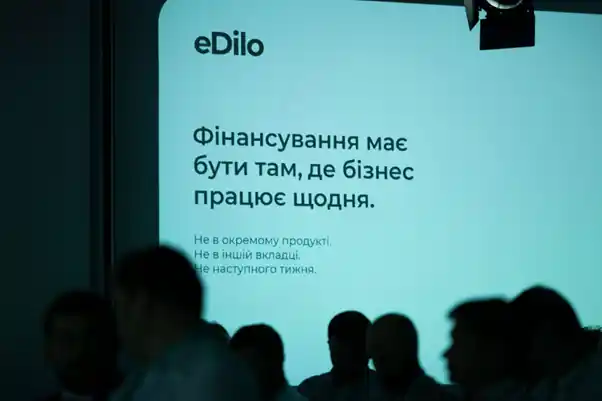
Organized by eDilo in partnership with Mastercard and UKRSIBBANK BNP Paribas Group, the conference focused on a simple principle: financing should be available to entrepreneurs when and where they actually need it — embedded directly into everyday business operations rather than separated from them by lengthy procedures.
Among the key areas discussed were the use of digital platform data to complement traditional credit assessments, the integration of deferred payment and installment solutions into business purchases, and new models combining private and donor capital for companies that struggle to access conventional bank financing.
From Applying for Finance to Using It When It Is Needed
For many Ukrainian MSMEs, access to traditional financing remains constrained by extensive reporting requirements, collateral requirements, and lengthy approval processes.
Yet for an entrepreneur, access to capital is often a matter of timing. Businesses need financing at the moment a specific operational need arises — to purchase inventory, pay an invoice, acquire equipment, refuel a vehicle fleet, or cover another immediate expense.
Embedded finance is designed to address precisely this challenge.
Instead of requiring a business to seek financing separately, financial tools can be integrated directly into the transaction itself. In the case of eDilo, financing can become part of a company’s regular procurement and payment processes, allowing entrepreneurs to access capital in the context of a specific business operation.
Conference participants discussed this model as a way to make financing faster, more accessible, and more closely aligned with the real needs of MSMEs.
“Embedded finance is not just another financial product; it represents an entirely different architecture for how businesses access capital. When financing no longer exists separately from the business process but becomes a natural part of it, entrepreneurs no longer need to search for financing separately. The system should be built around the person it exists to serve — and in our case, around the Ukrainian entrepreneur. “Ultimately, our goal is very simple: to enable Ukrainian businesses to grow faster than circumstances can hold them back. Money Should Follow Entrepreneurs.” – said Konstantyn Zhukovskyi, founder and shareholder of Activitis.
Data Can Open New Doors to Capital
Another important area of discussion was how banks, fintech companies, and large commercial platforms can assess businesses beyond traditional financial statements.
Digital platforms generate substantial amounts of operational data — including sales volumes, seasonality, demand patterns, payment history, and settlements. Participants discussed how this information can complement traditional financial reporting and provide a more comprehensive picture of a company’s actual business activity.
For smaller companies in particular, this could help bridge the gap between their real economic performance and what is visible through conventional credit assessment.
Financing Embedded Into Everyday Business Purchases
Several practical examples of embedded finance are already operating in Ukraine.
The WOG filling station network and eDilo have introduced deferred fuel payments for corporate customers. The solution allows businesses to access financing directly within their regular fuel purchasing process, rather than arranging a separate loan before making a purchase.
Epicentr Business and eDilo have also integrated installment payments into online procurement for companies and individual entrepreneurs. Businesses can therefore finance specific purchases directly at the point where the need arises.
The service is already being used by companies including Universum Clinic, UKLON, AUTONOVA-D, Mimibon, STV Group, and Franchise Group.
Combining Private and Donor Capital
The conference also explored financing models for entrepreneurs who remain underserved by the traditional banking system.
One potential approach is to combine private financing with donor capital, allowing financial institutions and fintech companies to reach businesses that might otherwise struggle to qualify for conventional lending.
Activitis is currently working with Mercy Corps on one such model, aimed at expanding financing opportunities for Ukrainian entrepreneurs.
The development of embedded finance in Ukraine has already moved beyond individual pilot projects. In June, eDilo launched installment payments for business customers of the Epicentr network. Earlier, Activitis also integrated eDilo for Glovo partners in Ukraine.
The broader ambition behind these initiatives is to change the logic of business financing: instead of requiring entrepreneurs to step away from their operations to search for capital, financing should become available naturally within the business processes they already use.
In other words, money should follow entrepreneurs — not the other way around.
Activitis is a Ukrainian fintech infrastructure company focused on developing B2B embedded finance solutions. The company builds and integrates financial tools since 2013 directly into business ecosystems and everyday commercial transactions, enabling companies to access financing at the point of need — whether for procurement, payments, equipment, fuel, or other operational expenses. Its eDilo service is designed specifically for the B2B segment to make financing a seamless part of business operations rather than a separate process.


.webp)































Comments