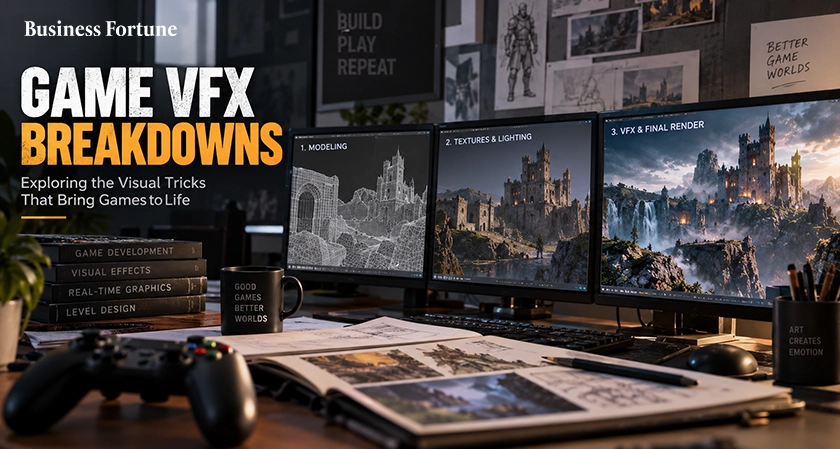
Explore how particles, shaders, lighting, animation and real-time techniques transform gameplay into immersive, visually engaging experiences for players.
Have you ever thought about how a game explosion becomes intense or how rain on the battlefield becomes realistic? All the answers lie in Game VFX Breakdowns. They break down all the amazing effects seen on screen and explain everything that is going on behind them. VFX in Games are not just about creating flashy graphics for a game. They serve purposes like conveying actions, establishing an atmosphere, improving storytelling and creating responsive gameplay. In this tutorial series, we will learn about VFX in Games, the process behind creating it, techniques of real-time VFX creation, tutorials for learning and types of VFX in games.
What Is Game VFX?
Game VFX, which stands for Game Visual Effects, are the special effects created to enhance the experience of playing video games by adding dynamism and immersion to the gaming experience. Examples of such effects include explosions, fire, smoke, magic, weather, lighting, water, sparks and charactern abilities. These effects are created and enhanced by artists to be integrated efficiently into a game engine as well as complementing its aesthetics. VFX artists make use of game engines such as Unreal Engine, Unity, as well as software designed for VFX. The VFX used in Games is of great importance in turning gameplay mechanics into an aesthetically pleasing experience.
How Does Game VFX Work?
Game VFX is achieved through the use of particles, animations, textures, shaders, lighting and sound. Whenever a player performs an action in a game, an effect is created automatically according to certain conditions. For instance, an explosion can trigger fire, smoke, sparks, lighting effects and debris at the same time. These elements are created by VFX artists through the use of applications like Unity or Unreal Engine and optimized to ensure smooth playability. The effects are intended to react based on the player’s behavior and the game environment, making the experience more realistic in terms of combat, movement, weather, magic and more.
How are complex game effects built, layer by layer?
The Game Visual Effects breakdowns illustrate the process behind creating and composing visual effects for the game. They usually divide the effect into its major components including particles, textures, meshes, shaders, lighting, animation and time. For example, the breakdown of an explosion could present how the effect starts with particles, progresses to smoke and fire and ends with sparks and debris.
Breakdowns of effects can also be created by artists, taking into account the way effects behave in the environment and react in response to gameplay. Breakdowns allow for a better understanding of the process involved in creating effects within games by artists and developers.
How Gaming VFX Is Created: A Step-by-Step Process
Game visual effects are the result of a process of creating visual effects that involve creativity and technical design to achieve impressive visual effects while maintaining fluid gameplay.
Concept and Reference Development
Artists begin with researching concept art, game mechanics, animations and real-life references to develop the effect’s style, coloring, size, timing and purpose within the game.
-
Study reference videos and visual effects
-
Review concept art and animations
-
Define the effect’s gameplay purpose
Particle System Creation
The particle system produces elements like sparks, smoke, fire, dust and luminous debris. Artists manipulate the way these elements look and move using parameters like motion, gravity, color, transparency and lifetime.
-
Set up particle emitters
-
Control speed, gravity and movement
-
Adjust color and transparency over time
Shader and Material Development
They define how VFX will interact with the light and be rendered on screen. Artists utilize shaders and materials to create glow, transparency, distortions and animated visuals.
-
Adjust glow and emission
-
Create transparency gradients
-
Add animated textures and energy patterns
Engine Integration and Optimization
When the effect is created, it is incorporated into the game engine by the artists, where it is tested while playing the game. They make sure that the number of particles, timing and complexity do not hinder its performance.
-
Reduce unnecessary particles
-
Fine-tune timing and visual clarity
-
Test effects in different gameplay situations
5 Best Game VFX Breakdowns
Why are the most interesting best game VFX breakdowns valuable? They showcase how artists can use their imagination and technology to create compelling effects.
God of War: Ragnarok
Effect Breakdown in God of War: Ragnarök focuses on the various visual effects utilized for the player's combat moves, weapon skills, elemental attacks and environmental effects. Particles, lighting, texture and animation techniques are used to achieve impactful yet responsive effects during gameplay.
League of Legends
There are good examples of game VFX from the game League of Legends. This game's breakdowns provide a great insight into the way that artists can create stylistic visual effects by using particle systems, hand painted textures and animation and color based effects.
Fortnite
Fortnite proves that in real-time visual effects, stylization and efficiency can coexist successfully. The visual effects of the game incorporate the usage of particles, meshes, materials, animation and lighting to make weapons, environmental effects, celebrations and abilities. By studying breakdowns, one can observe how artists manage to balance visuals and performance.
Valorant
Valorant offers excellent case studies of VFX designed for gameplay purposes. The particle systems, shapes, lighting and animation used in the ability effects instantly identify them. Through VFX breakdowns, we see how the artists give priority to clarity, timing and consistency, making sure that the effects look great while assisting players in comprehending what is going on in the game.
The Last of Us Part II
VFX in the environment and gameplay in The Last of Us Part II include dust, smoke, fire, weather, debris and atmosphere. Its failures show how several different subtle layers can be used to achieve realism. The artists skillfully combine these elements with lighting, animation and environment to enhance immersion without detracting from the game itself.
How do game VFX tutorials help artists create real-time effects?
Game VFX tutorial videos assist novices in learning about the working of particles, shaders, textures, animation, lighting and game engines to create effective visual effects.
Unreal Engine VFX Tutorials
Unreal Engine Visual Effects tutorials help artists learn about Niagara, which is the visual effects system in Unreal Engine. Some typical elements that tutorials teach include particles, explosions, smoke, fire, magic, environmental effects and interactive visual effects. They teach artists how to manage time, motion, material and performance for their effects.
Unity VFX Tutorials
The Unity VFX tutorial teaches the artist on how to create visual effects through the use of particle systems, Visual Effect Graph, shaders, textures and animations. The visual effects range from fire, sparks, explosions, energy blasts, weather effects and magic effects. Through these tutorials, one learns how the various visual components work together to create visual effects.
Explosion VFX Tutorials
Tutorial for Explosion Effects is all about creating multiple layers such as fire, smoke, sparks, debris, lighting and distortion. Artists are taught to manage timing, scale, motion and colors to create an impressive explosion effect. Moreover, tutorials will teach artists the methods of optimizing their effects for better performance in game environments.
Magic VFX Tutorials
Magic Visual Effects tutorials help users learn how to create various effects such as energy attack effects, spells, glow effects, portals, shields and many more. Tutorials involve learning how to use particles, animated textures, shaders, distortion and lighting to achieve this effect. This is especially important when it comes to visual feedback of game abilities.
Environmental VFX Tutorials
These tutorials cover everything from creating rain and snow to creating dust, fog, wind, water, leaves falling and many more atmospheric elements. This allows game developers to learn how particle effects and shaders can be used in game environments without affecting the game's performance negatively.
How do real-time VFX stay impressive and efficient?
The real-time VFX breakdown demonstrates how artists work with particles, shaders, textures, animation, lighting and optimization to design responsive effects for games.
Real-Time Explosion Effects
The explosion breakdowns reveal how fire, smoke, sparks, particles, deformations and lighting come together into a cohesive whole. The artists have control of all these elements through particles, materials and animations. The breakdown illustrates how timing and scale contribute to the effect without being too dominant or using up too many processing resources.
Real-Time Magic Effects
Breakdown of Magic VFX consists of energy beams, glowing particles, trails, bursts and animated textures. Through using shaders, particles, distortion and lighting effects, artists can achieve stylization for abilities. In the breakdown, you can see how different layers work and how color and motions distinguish various abilities from each other.
Real-Time Environmental Effects
Environmental breakdowns are an analysis of how elements such as rain, fog, dust, snow, wind and falling leaves behave. Particles, shaders, lighting and environmental interaction are some techniques used by artists to develop atmosphere. The breakdowns are examples of how even slight motion and density control can achieve realism.
Real-Time Weapon Effects
A Weapon VFX breakdown shows how the muzzle flash, projectile, spark, trail, impact, smoke and energy effect are created. Artists coordinate visual components with animations and game mechanics to deliver instant feedback. The breakdown is also focused on optimization to ensure that the effects stay clear and responsive in intense battles and repeated interactions.
How does VFX make games more immersive and exciting?
Game VFX adds movement, atmosphere, impact and realism to the game world, transforming basic game actions into something more visual by adding effects, lighting, simulation and animation.
Particle Effects
Particles appear in games in various forms including smoke, fire, sparks, dust, magical streaks and energy. Thousands of particles are able to act together and bring action into life. The movements, sizes, timings and densities of particles are precisely controlled by artists in order to achieve convincing effects without impacting the game performance.
Environmental Effects
Rains, snows, fogs, winds, dust and other environmental elements have the power to totally transform the atmosphere of the gaming world. These VFX help make the location vibrant instead of passive. Artists employ particles, shaders, lights and animations to generate believable environments which interact with their surroundings.
Lighting Effects
A sense of drama, mystery, warmth, or intensity can be created through proper lighting in a game environment. The use of lights, shadows, reflections, glow and other special effects in VFX allows for better character and environment rendering in addition to providing a more intense experience in-game.
Explosions and Destruction
Explosions and effects of destruction are an immediate source of energy in gameplay. Fire, smoke, sparks, rubble, shock waves and destruction of the environment can all be utilized to create impacts which are intense. These effects have to be coordinated with animation and gameplay to achieve realism without compromising responsiveness.
Fluid Simulation
The process of fluid simulation enables the replication of the flow of fluids like water, lava and mud. Artists rely on simulations and visualization technologies to generate such phenomena as splashes, waves, streams and surface motion. Such an approach brings in another dimension of reality, especially for games set at sea or river environments.
Final Thought
Future advancements in the realm of visual effects for video games will become even more dynamic because of the improvements in the fields of real-time rendering, AI-based generation, simulation and game engines. Tasks which used to take a lot of time to create might now be done quicker, leaving space for creativity. Real-time visual effects will also become more prominent in the creation of interactive environments where weather, destruction, lighting and abilities of the characters respond naturally to actions taken by the player.
On the other hand, performance optimization will continue to be important as the games strive for improved visuals on various devices and platforms. According to Business Fortune, game visual effects have become more than just visual enhancement.
It has become a significant aspect of game designing and gameplay. With the advancement of technology, the role of artists who can combine creativity with knowledge of technology in making the next-generation interactive games will be more important than ever before.


.webp)





























Comments