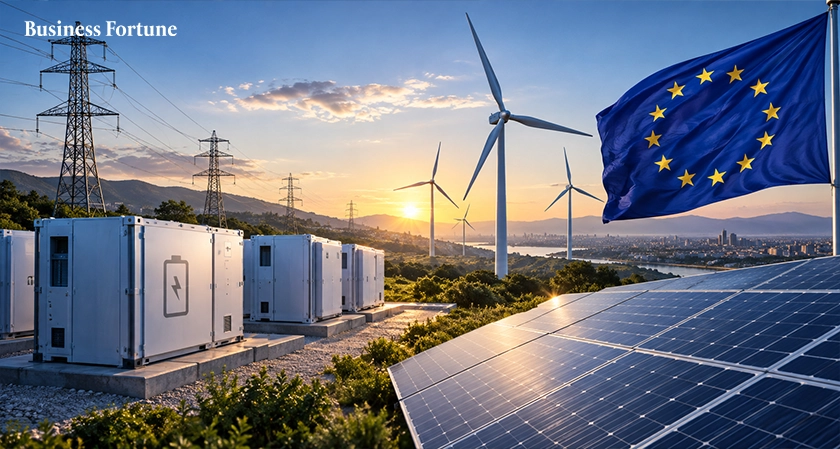
Europe is reshaping its clean energy approach as grids, storage, flexibility and financing become increasingly important for meeting climate targets.
The EU renewable energy policy framework is likely to undergo an overhaul in the coming years after 2030, with more attention being paid to grids, storage, flexibility and financing. The European Commission organized a public consultation in March 2026 in order to develop the policies to be followed in the coming ten years concerning renewable energies, guaranteeing that there will be dependable and cheap sources of energy without violating the mandatory 2040 climate goal.
Why is Europe reconsidering its renewable strategy?
Eurostat has reported that the gross final consumption of energy from renewable sources constituted 26.2% of the total gross final consumption of energy in the EU in 2025 as against 25.2% in 2024. However, the target for 2030 is at least 42.5%, with ambitions of achieving 45%.
The post-2030 framework that the Commission will adopt is not only about setting further goals but is also about making sure that renewables are integrated better, transportation is decarbonized, as well as heat, cooling and industry.
Key points:
-
EU renewable energy reached 26.2% in 2025.
-
The binding 2030 target stands at 42.5%.
-
Grid investment is becoming central to clean power.
-
Storage can help balance variable renewable generation.
-
Flexibility could improve electricity-system efficiency.
What could change after 2030?
One of the key concerns the ability of Europe to develop sufficient infrastructure to harness the energy from its renewable electricity production. Both wind and solar power facilities can be built at rapid rates, however, insufficient transmission capacity and storage may become problems. Based on the figures provided by the Commission, Europe would require around €730 billion and €477 billion for distribution and transmission infrastructure by 2040 respectively.
Grid modernization is thus increasingly important for the transition of the EU’s energy system. Interconnections, storage and demand side management could enable better integration of renewables.
The debate on policy is also related to electric vehicles, intelligent charging and greater electrification. This technology could help in making electricity demand flexible, thus being able to accommodate excess renewable energy production.
The Commission claims that its new framework after 2030 aims at supplying energy that is affordable and reliable in order to promote energy security and competitiveness. The legislative proposal will be adopted before the year 2026.
With regard to Europe, the next step may not necessarily be increasing renewable energy production but rather providing that it will be delivered to the right place and at the right time.
Thus, Business Fortune believes that Europe’s renewable future will depend on stronger grids, storage, flexibility, and smarter energy investment.


.webp)




























Comments