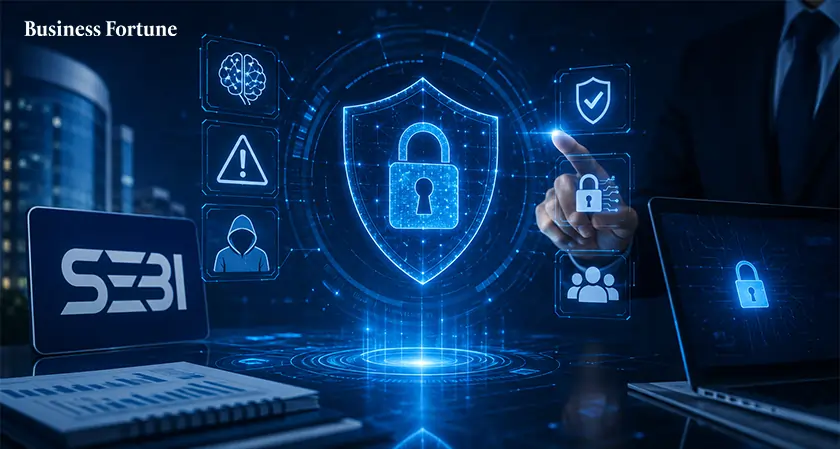
India's market regulator strengthens digital resilience as AI-driven security challenges reshape cybersecurity strategies across financial institutions with proactive risk measures.
The Securities and Exchange Board of India (SEBI) has launched a dedicated task force, cyber-suraksha.ai, to address rising SEBI AI cyber threats linked to rapid artificial intelligence advancements. The regulator is examining risks from AI-based vulnerability identification platforms, including tools such as Claude Mythos, which can accelerate cyber risk detection but may also increase exposure to large-scale attacks.
SEBI aims to strengthen cybersecurity coordination across India’s securities market through improved threat intelligence sharing, continuous monitoring and unified risk management strategies.
SEBI Targets Emerging AI-Based Security Risks
Market infrastructure institutions (MIIs), qualified registrars and transfer agents (QRTAs), regulated companies and other industry stakeholders are represented on the recently formed task force. Its main goals are to assess cybersecurity issues related to artificial intelligence, develop frameworks for mitigation and ensure that serious cyber incidents occur faster.
At a recent task force conference, possible concerns related to AI-powered platforms were examined and preventive actions were proposed. Following these talks, SEBI released a recommendation for regulated companies to strengthen their cybersecurity processes and get ready for new digital risks.
Key measures recommended by SEBI include:
-
Immediate patching of critical system vulnerabilities
-
Regular AI-based vulnerability assessments and security reviews
-
Stronger vendor risk management across digital ecosystems
-
Enhanced API protection and change management controls
-
Continuous SOC monitoring for real-time threat detection
Building a Safer AI-Based Financial Ecosystem
According to SEBI, proactive cybersecurity measures are necessary for interconnected financial systems. The regulator has urged organizations to create safe AI adoption procedures, harden infrastructure, strengthen asset inventories and perform regular risk assessments.
Additionally, the advice supports the Market-SOC platform's onboarding, which is intended to facilitate real-time cyber threat identification and response. SEBI seeks to reduce the probability of cascading cyber incidents impacting India's securities ecosystem through coordinated monitoring and information exchange.
As financial institutions rely increasingly on automated technologies, the emergence of AI cybersecurity vulnerabilities has become a significant issue. Artificial intelligence tools can enhance security operations by identifying weaknesses more quickly, but they also necessitate strict governance, ongoing evaluation and responsible deployment.
A larger effort for cyber resilience in financial markets is reflected in SEBI's most recent initiative. The regulator thinks that in order to handle future AI-related risks, cooperation between institutions, IT services and industry participants would be essential.
Thus, Business Fortune believes that SEBI’s AI security measures will strengthen defenses against evolving digital threats.
FAQs
Why has SEBI created the cyber-suraksha.ai task force?
SEBI formed the task force to address emerging cybersecurity challenges caused by rapid AI advancements and evolving digital threats.
How are AI tools creating new cybersecurity concerns for financial markets?
AI-powered vulnerability identification tools can detect weaknesses faster, increasing the need for stronger security controls and continuous monitoring.
Who are the key participants in SEBI’s cybersecurity task force?
The task force includes market infrastructure institutions, regulated entities, qualified registrars, transfer agents and other market stakeholders.
What cybersecurity measures has SEBI recommended for regulated entities?
SEBI has advised regular vulnerability assessments, system patching, vendor risk management, API security improvements and continuous SOC monitoring.
How will Market-SOC help India’s securities ecosystem?
Market-SOC will support real-time threat detection, cybersecurity coordination and faster responses to potential cyber incidents across financial markets.


.webp)

























Comments