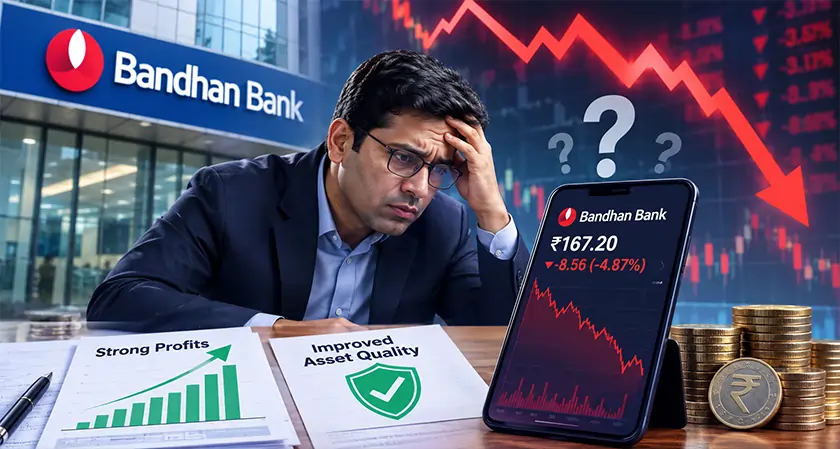
Strong earnings, improving asset quality, and rising profits, so why did Bandhan Bank share crash? Here's what the market focused on instead.
Bandhan Bank share became one of the biggest talking topics in the market on Wednesday after the stock plunged nearly 18% despite the lender reporting a strong set of first-quarter results for FY27. The sharp fall left many investors surprised, as the bank posted higher profits and improved asset quality. However, the market appeared more concerned about what lies ahead than what the bank achieved in the last quarter.
The stock dropped to an intraday low of ₹171.56 from its previous close of ₹208.83 and entered the NSE cooling-off period after falling more than 10%. Even later in the session, selling pressure remained strong.
Investors Looked Beyond Earnings
Bandhan Bank reported a 35% year-on-year rise in net profit to ₹501.66 crore for the April-June quarter. Interest income also increased to ₹5,630.55 crore, while provisions for bad loans fell sharply by 40%.
Despite these positives, investors focused on management’s decision to lower its Return on Assets (RoA) guidance for FY27. The bank reduced its expected RoA range from 1.6%-1.8% to 1.2%-1.4%, signalling that profitability could remain under pressure in the coming quarters.
A lower RoA generally suggests weaker profit generation from assets and often raises concerns about future earnings growth.
Why Did the Market React So Strongly?
The biggest concern was the bank's warning that higher deposit costs could continue to pressure margins. Management also highlighted challenges such as rising technology expenses, funding costs, global economic uncertainty, and monsoon-related risks.
Analysts at JP Morgan said tighter liquidity, elevated funding costs, and increasing technology investments were key reasons behind the reduced profitability outlook. The brokerage also pointed out that the bank lowered its Net Interest Margin (NIM) guidance from 6.5% to 6.2%.
Meanwhile, in the Share market today, investors appeared to prioritize future growth expectations over current financial performance.
Asset Quality Continues to Improve
One bright spot in the earnings report was the steady improvement in asset quality. The bank's gross NPA ratio improved significantly to 3.15% from 4.96% a year ago. Gross NPAs declined to ₹4,880.94 crore from ₹6,622.63 crore, reflecting healthier loan recovery and stronger credit management.
These improvements helped reduce provisioning requirements and supported profit growth during the quarter.
A Battle Between Strong Numbers and Weak Guidance
Bandhan Bank's latest results highlighted a clear market reality that investors often care more about future earnings than past performance. While profits grew and bad loans fell, the cautious outlook on margins, profitability, and loan growth overshadowed the positive quarterly numbers.
As Business Fortune observes, investors will closely watch whether funding costs ease, margins stabilize, and loan growth picks up. If these concerns improve, Bandhan Bank could regain market confidence. Until then, the stock may continue to face instability.
FAQs
Why did Bandhan Bank shares fall despite strong Q1 results?
The stock fell mainly because the bank lowered its profitability guidance for FY27, raising concerns about future earnings and margins.
What was Bandhan Bank's net profit in Q1 FY27?
The bank reported a net profit of ₹501.66 crore, up 35% compared to the same quarter last year.
What is RoA and why is it important?
Return on Assets (RoA) measures how efficiently a bank generates profit from its assets. A lower RoA outlook often signals weaker profitability.
How did Bandhan Bank's asset quality improve?
Its gross NPA ratio improved from 4.96% to 3.15%, while gross bad loans declined significantly during the quarter.
What should investors watch going forward?
Key factors include funding costs, net interest margins, loan growth, technology expenses, and the overall economic environment that could influence future profitability.


.webp)































Comments