Leading Companies of the Year 2026
Business Fortune
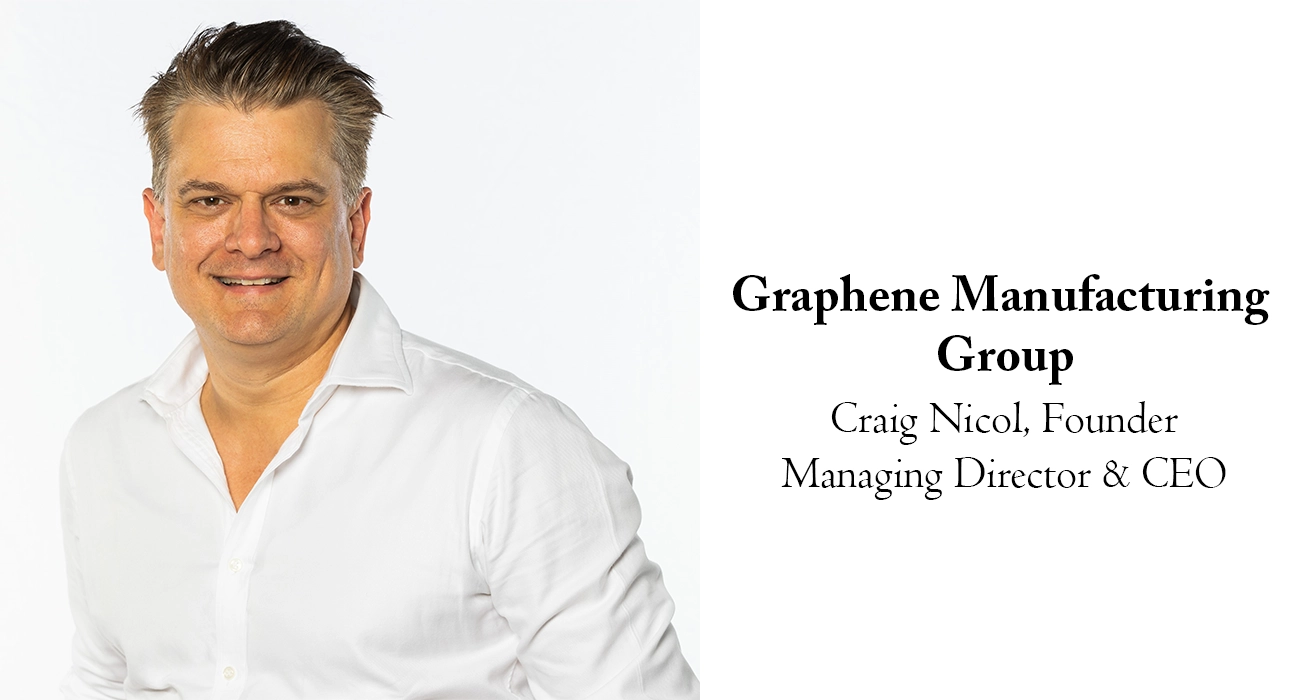
Graphene Manufacturing Group (GMG) is a clean technology company developing graphene-based solutions designed to improve energy efficiency and sustainability. Founded in 2016, the company was built around the opportunity to convert the carbon in natural gas directly into graphene, avoiding reliance on mined graphite. By 2018, GMG had developed and proven its proprietary plasma-based production process.
GMG’s portfolio includes THERMAL-XR® heat-transfer coatings, G® LUBRICANT, graphene additives for lithium-ion batteries, and a next-generation graphene ion battery. The company is expanding manufacturing capacity and commercial partnerships while targeting applications across HVAC-R, data centres, industrial operations, transportation, mining and energy.
With a focus on scalable production and measurable performance, GMG is working to move graphene from an advanced material into commercially viable applications that support the global clean technology transition.
Interview Highlights
What are some of the biggest challenges facing the graphene and clean technology industry, and how is GMG helping address them?
The industry’s biggest historical challenges have been consistency, purity, cost and scale – producing graphene of repeatable quality, at a price and volume industrial customers can build products around, and converting that material into applications with measurable value. Because GMG makes graphene from natural gas rather than mined graphite, our material is inherently low-contaminant and ‘tuneable’ for each application, and our modular production technology scales as demand grows – our Generation 2.0 plant started up on schedule in June 2026 and is expected to lift capacity to around 10 tonnes per annum, that would provide enough coating for 1 million air conditioners or 8 GW of data centre cooling with our THERMAL-XR graphene coating or thousand’s of graphene ion batteries or millions of litres of fuel potentially saved with our G LUBRICANT when used in large trucks. We have also completed key regulatory steps, including US EPA approval to import and sell our THERMAL-XR® coating system in the United States, and we sell on quantified energy and emissions outcomes.
GMG has developed a proprietary graphene manufacturing process. How does this technology differentiate the company and create value for customers?
Our proprietary process uses plasma to decompose natural gas – methane – into carbon, in the form of graphene, and hydrogen. Because we don’t use mined graphite, there are no mineral impurities to remove; the result is high-quality, low-cost, scalable and contaminant-free graphene that we can tune to each end product. That purity translates into performance in our THERMAL-XR® coatings, G® LUBRICANT and battery products.
The economics are equally compelling. Natural gas is a low-cost, abundant feedstock, while hydrogen-rich tail gas can help power production. Our Gen 2.0 plant is expected to be largely self-powered using renewable generation, energy storage and tail-gas power. Because plants are modular, we can add capacity with sales, close to customers and low-cost gas anywhere in the world.
How do you balance ongoing research and development with the commercialization of new graphene-based products?
We run them in parallel, with discipline. Three of our four product families – THERMAL-XR®, G® LUBRICANT and our graphene additive for lithium-ion batteries – are in commercial production today, generating revenue, customer feedback and manufacturing know-how that feed back into development. That commercial discipline keeps our R&D focused – every programme must ultimately earn its place with customers. Our fourth product, the graphene ion battery, is managed through a stage-gated Battery Technology Readiness Level framework, so investment follows demonstrated results. Partnerships with the University of Queensland, Rio Tinto and the Battery Innovation Center in Indiana let us share risk and access world-class capability, while customer pull ultimately decides where we put our energy.
Your solutions are designed to improve energy efficiency and sustainability. How do you believe GMG is contributing to a cleaner and more sustainable future?
GMG believes that we (us and our customers) can do better with GMG’s products. Energy efficiency is the fastest, cheapest lever for decarbonisation, and that is where our products work every day. THERMAL-XR® restores and improves heat transfer in HVAC-R systems, data centres and industrial plants, cutting electricity use and extending equipment life. G® LUBRICANT reduces friction and has demonstrated fuel savings of around eight per cent in heavy equipment. Our next generation graphene ion battery avoids lithium entirely – built on abundant, recyclable materials, it charges in around six minutes and greatly reduces thermal runaway risk, opening the door to electrifying heavy equipment that cannot wait hours to charge. Even our manufacturing supports the mission: producing graphene from methane yields clean hydrogen as a co-product, and our new plant is designed to be largely self-powered from renewable sources.
Partnerships with industry, research institutions, and customers play an important role in innovation. How have these collaborations supported GMG’s growth and product development?
Collaboration is central to how we work. Our battery programme is a joint effort with the University of Queensland, supported by the Australian Government, under a Joint Development Agreement with Rio Tinto, with cell testing supported by the Battery Innovation Center in Indiana. In July 2026, we signed a global exclusive MOU with Alstom to develop graphene products for rail HVAC systems – powerful validation of our technology from one of the world’s leading transport companies, and a model for entering other industries. On the commercial side, distribution partners take our products to market at scale: Nu-Calgon in North America – where THERMAL-XR® is sold as CoolWorx® powered by GMG® Graphene – Beijer Ref and Blackwoods across Australia, among others.
As demand for advanced materials continues to grow, what opportunities do you see for graphene across industries over the next few years?
The opportunity set is expanding quickly. Data centres are an enormous near-term market – the AI build-out is fundamentally a cooling and energy problem, and our coatings improve heat transfer where it matters. HVAC-R retrofits, industrial process plants and LNG facilities offer similar efficiency gains. In transport, our Alstom partnership opens rail, while mining and heavy mobile equipment are target use cases for our six-minute-charging battery. Add graphene additives that improve the charging speed of today’s lithium-ion cells, and I believe graphene is moving from laboratory curiosity to industrial input. Over the next few years, I expect the winners will be companies that pair reliable, high-quality graphene supply with proven, quantified applications – precisely the position we have spent a decade building.
Looking ahead, what are GMG’s key priorities for growth, innovation, and expanding its global impact in the clean technology sector?
Our priorities are clear. First, complete the optimisation of the Gen 2.0 plant and progress our next-generation modular graphene plant, for which the Board has approved the next stage of detailed design. Second, scale commercial sales – June 2026 was a record month with over A$400,000 in orders booked – with North America production expansion a key focus following EPA approval. Third, advance the graphene ion battery through customer cell testing in 2026 towards small commercial production in 2027 with our partners. Finally, keep building the global distribution network and partnerships that turn our technology into worldwide impact.
Short Bio - Craig Nicol
Craig Nicol is the Founder, Managing Director and CEO of Graphene Manufacturing Group (GMG). Before founding GMG in 2016, he spent two decades with the Shell group of companies, where he led large-scale innovation initiatives, including multi-billion-dollar gas and LNG value chains across Australia and Asia Pacific, as well as regional sales and marketing teams.
Craig holds a Bachelor of Engineering in Manufacturing Systems (Honours) and a Bachelor of Business in Marketing from Queensland University of Technology. He is a member of the Australian Institute of Company Directors and has served as Chair of the Australian Graphene Industry Association and Founder, Inaugural Chair and Director of Australia’s Advanced Materials and Battery Council.
“GMG is building graphene into a commercially viable industrial material through proprietary manufacturing, strategic partnerships and practical applications that deliver value across global clean technology markets.”
















.webp)