
Most scaling failures come from pairing the wrong framework with the problem. This guide sorts the best frameworks COOs use into four layers and shows which breakdown each one actually fixes.
Best Frameworks COOs Use to Scale Operations Without Losing Efficiency
Only 22 percent of employees would describe their leader as having a clear direction for the organization, according to research cited by McKinsey in their work on the COO agenda. The gap widens as growth continues. The most effective frameworks upon which COOs operate do not compete: each rules a different layer of the company and efficiency leaks when asked to do the other's job.
That's the point here. A COO who pulls out Six Sigma when the real problem is strategic drift will create nice-looking graphs and nothing more. One that installs a weekly meeting rhythm while a single bottleneck starves the line will enjoy tidier meetings about the same stuck line. Matching tool to breakdown is the skill. What follows: four layers, five frameworks and a short diagnostic for choosing.
Which frameworks do COOs actually rely on?
Five of the frameworks favored by COOs recur. They fall into four layers: direction, rhythm, flow and variation.
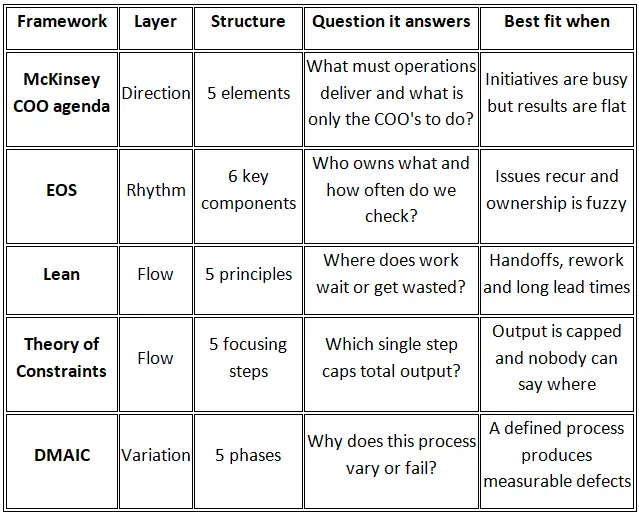
McKinsey’s COO agenda
McKinsey’s five component agenda covers vision, plan and delivery, stakeholder management, organization and talent and a personal operating model. It’s most interesting idea is borrowed from the military: the leader states his intent, leaving subordinates to interpret it in a way consistent with the goal, allowing for flexibility at a distance.
The agenda also specifies that the COO should focus on his own agenda, with the emphasis on time management: several interviewed COOs report that they spend no more than a third of their time actually overseeing operations. McKinsey’s agenda is not about fixing the second line, but prioritizing the ones to fix.
EOS
Gino Wickman’s Entrepreneurial Operating System, which is bundled in six business areas and fixed timing of scorecards, priorities and issue-solving meetings. Its main benefit is establishing the rhythm: ownership is specified, finances are reviewed and problems are solved weekly, instead of periodically.
EOS Worldwide recommends using Lean and Six Sigma process improvement frameworks within the Process component of EOS, which speaks for the value of this component: it contains the right mental model for improvement: a consistent schedule beats random gatherings. The alternative to EOS is OKRs, which is more flexible in timing and applicable beyond entrepreneurial companies, according to WhatMatters. Therefore, to prescribe and solve, choose EOS; to set ambitious, negotiable goals, choose OKRs.
Lean
The Lean philosophy is based on five principles: value, value stream, flow, pull and perfection, established by Womack and Jones. The Lean Enterprise Institute, in turn, recommends adopting the shift from “optimizing individual assets and functions” to “optimizing the value stream,” which is defined as “a series of steps that cross functional lines and that adds value to the product or service.”
Therefore, for scaling, this is a crucial distinction: adding more teams creates more handoffs and the point of the value stream is to make these handoffs visible, since it is where waiting occurs, which hides the lack of ownership. Among the process improvement frameworks, Lean explicitly addresses the issue of waiting; McKinsey’s agenda also suggests Gemba walks for the same reason.
Theory of Constraints
The Theory of Constraints (TOC) was introduced in 1984 by Eliyahu Goldratt in the novel The Goal . It is a systems theory that asserts that in any process, a constraint (bottleneck) determines the maximum output for the system, while improvements to other elements are wasted. TOC prescribes five steps: identify the constraint, decide how to utilize it maximally, structure the rest to support the constraint, move the constraint and repeat.
As our article notes, the main idea of the theory is not contradicted by Goldratt himself: in a growing company, the constraint moves and the job of the COO is to recognize it before it becomes “last year’s constraint.” In other words, when the next step in the growth chain becomes the limiting factor, the COO should be prepared to address it.
DMAIC
ASQ lists DMAIC as a process improvement approach, which stands for define, measure, analyze, improve and control. It is similar to the other process improvement methodologies, such as Six Sigma: its purpose is to bring the existing process under control, determine the reasons for defects and eliminate them.
ASQ also notes that there is another acronym, DMADV, which is used for design or improvement projects with a complete redesign of the system. In other words, to tweak a process, use DMAIC; to design a system from scratch, use DMADV. Meanwhile, McKinsey’s article mentions the opportunity to scale operations using the DMAIC process: “A 10-percent finished scrap rate equals a 10-percent lost capacity,” it notes. “This is a significant amount of capacity that has already been amortized over the life of the asset.”
Therefore, according to McKinsey, a kaizen event, which is a process improvement activity, can be scheduled at a regular interval if a part-time team is available; otherwise, a kaizen event takes about a month (ASQ).
How can a COO choose between them?
The authors recommend asking four questions in order, stopping at the first one that is “yes.” Are processes not working despite teams’ efforts? This is a direction issue; proceed to McKinsey’s agenda. Are the same problems recurring at regular intervals without ownership? This is a rhythm issue; set a regular meeting time and review the key processes. Is there waiting between teams or hitting the ceiling? It is a flow issue; map the value stream and look for the constraint. Is a consistent process delivering consistently inconsistent results? It is a variation issue; use Six Sigma’s DMAIC.
The order is essential: if a COO addresses a higher-level issue (variation) first when there is a lower-level one (direction), the process improvement will fail because the resources will be used incorrectly. Similarly, if a COO focuses on a lower-level issue (direction) when a higher-level constraint (variation) is present, the process improvement will be wasted on an unnecessary endeavor.
What are the typical pitfalls of the COO frameworks?
They are of two kinds, and both relate to the communication infrastructure.
First, there is confusion between frameworks and actual metrics: the authors’ article contains multiple examples where teams compete for the best numbers, not customer satisfaction. McKinsey gives an example of managers asking each morning how many maintenance jobs have been done: crews would prioritize small, quick tasks and defer major ones, creating a “debt.”
Second, teams wrongly use communication tools for transformation and not addressing the underlying issues. McKinsey lists four approaches that are more likely to ensure transformation success: role modeling, understanding and conviction, skill building and formal reinforcement. In other words, to achieve the desired result, a COO may need to do more than communicate; according to McKinsey’s article, the majority of transformations fail due to cultural and people-related issues.
More to Know
The COO’s role is not standardized. An article by Nathan Bennett and Stephen Miles in the Harvard Business Review in 2006 identified seven types of COOs, including the Executor, the Change Agent and the Heir Apparent. It also notes that there is no “universal set of competencies that define a great COO,” and that the key to success depends on the relationship between the COO and the CEO. In other words, the COO’s approach is contextual and depends on the personality. Operations strategy can be determined by the type of COO.
The COO’s role is future-oriented. McKinsey notes that over 25 percent of the CEOs of the Fortune 500 companies were previously COOs.
Transformations are inherently complex. McKinsey reports that around 70 percent of corporate transformations in its database have failed, with cultural and people-related issues being the reason in most cases.
AI is an enabler, not a goal in itself. According to a survey of 1,719 executives conducted by McKinsey and published in Unite.AI, 44 percent of respondents have already implemented AI across the enterprise, an increase of 6 percent from last year. However, only 37 percent of executives could demonstrate an impact on EBIT. Therefore, use AI within the framework of the process improvement methodology.
None of the tools directly scale a company. The agenda sets the strategy; the cadence establishes ownership; value stream and constraint analysis identify the flow; finally, the DMAIC framework addresses variations within the process. All these levels address the critical causes of process deterioration. Each has a place in operating strategy, but none can replace the others. The tools should be used as is: try to name the layer that deteriorated and select the corresponding methodology. Then, select one tool, change one metric and see how it works within a quarter.
Business Fortune believes it is an obvious recommendation, but the example of the mining company, with its green sites and red company, is a warning to everyone who prefers flashy methodologies.
.webp)


























Comments