Business Fortune
A strong human resources department is the foundation of any successful company. Businesses have the potential to grow quickly, particularly if they are well-run and offer top-notch products or services. When a company reaches a certain size and profit margin threshold, hiring HR staff or using HR consulting services becomes a compelling option. Employing HR consulting services can differ from business to business, but there are measurable benefits to doing so.
It's critical to select the correct partner if you've made the decision to collaborate with an outsourced HR provider in order to reduce your workload and maintain compliance. You should take your time assessing each HR provider's distinct offers because every one is a little bit different in order to choose the one that will work best for your business.
WorkMotion is among the top providers of HR solutions. WorkMotion's global HR platform enables businesses to hire and onboard staff members worldwide. Their goal is to make it possible for anyone to work remotely. Over 160 nations have benefited from WorkMotion's simplified international hiring, onboarding, and HRM processes.
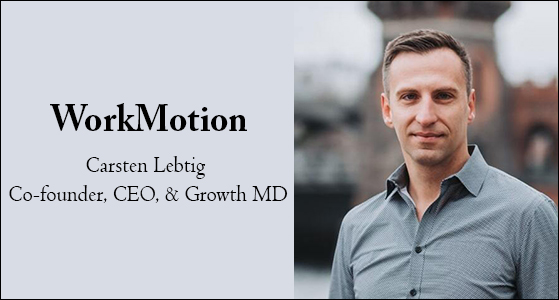
Let's have a conversation with WorkMotion's co-founder, CEO, and growth managing director, Carsten Lebtig.
What inspired the founding of WorkMotion? As the company's CEO, how has the journey been for you?
Felix Steffens, Karim Zaghloul, and I launched WorkMotion in July 2020 to help with the pandemic-related problem of enabling workers worldwide to work from home.
Our platform gives businesses the onboarding and compliance tools they need to select the best candidates for the greatest positions available globally. Our clients may effortlessly integrate foreign talent from more than 160 nations while adhering to the unique employment regulations of each jurisdiction.
As a business owner, I'm constantly searching for solutions to the problems that confront us in this fast-paced world. Felix, Karim, and I took advantage of the opportunity presented by the pandemic to ensure that businesses could adjust to this transformation in a way that would both future-proof their operations and satisfy the needs of their growing globally scattered workforce. Although the road has been both rewarding and occasionally difficult, we are eager to move on to the next phase of the procedure.
Why is WorkMotion still important in the modern era? Could you provide some background?
The fact that remote working has endured past the first few months of lockdown shows how popular it is for today's worker to be able to work from anywhere, whether it be at home to assist with childcare or overseas to see different cultures.
According to a Randstad survey from 2022, 40% of Gen Z employees and 41% of Millennials would turn down a job offer if it didn't offer flexible work schedules. When you combine this with the global talent competition during the Great Resignation, flexible working solutions become not only highly wanted but also a good way to secure one's future.
In fact, organizations are reshaping the workplace, and individuals have more agency than ever before. These exciting times allow organizations to expand teams abroad fast and compliantly without being hampered by national employment restrictions by digitizing laborious onboarding processes.
In what ways is WorkMotion upending the status quo?
First off, we are revolutionizing the way businesses utilize talent by providing opportunities for them to recruit staff from a worldwide talent pool. For example, giving talent to nations that are frequently thought to be too difficult to employ from opportunity or bringing in a wide mix of skills to expand any business's knowledge, capabilities, and strategy.
Second, we are assisting in the transformation of the workplace to better suit new modes of operation. We are fighting for regulations to be changed to better accommodate today's digital, remote workers, including how remote and temporary workers abroad are taxed and compensated, by enabling businesses to attract and retain talent globally.
For WorkMotion, what does innovation mean?
Our innovation begins by removing the obstacles of locality inside a strategic hiring process, and our eyes are set on revolutionizing how the entire globe hires its personnel.
We accomplish this by creating a product that is intended to make the difficult simple using in-house knowledge and technology. Our technology, "The Global Talent Operating System," assists companies in managing and hiring personnel across borders. Employers can negotiate the challenges of remote work with the aid of our completely compliant employment solutions and workflows, which cover everything from benefits and temporary work to mobility and payments.
In order to stay up to date with the most recent national labor laws and regulations, we also develop customized workflows at the national level based on the locations where our clients are seeking to hire. We can offer information to help HR develop right and compliant-friendly offers.
We are constantly seeking methods to increase our offerings and skills. We're constantly coming up with new ideas, including our country-specific salary advice tool, Personio and BambooHR interfaces, and contract creation engine!
Using WorkMotion, advancing innovation in worldwide HR solutions
Carsten Lebtig is WorkMotion’s Co-founder, CEO, and Growth Managing Director. He began his career at McKinsey before going on to become a prosperous investor and entrepreneur. He founded test.io in 2011, which is the top platform in Europe for hiring and discovering remote software testers. He eventually developed Sanubi.de and served as General Manager at UBER until starting WorkMotion with Felix and Karim in 2020.
.webp)