Business Fortune
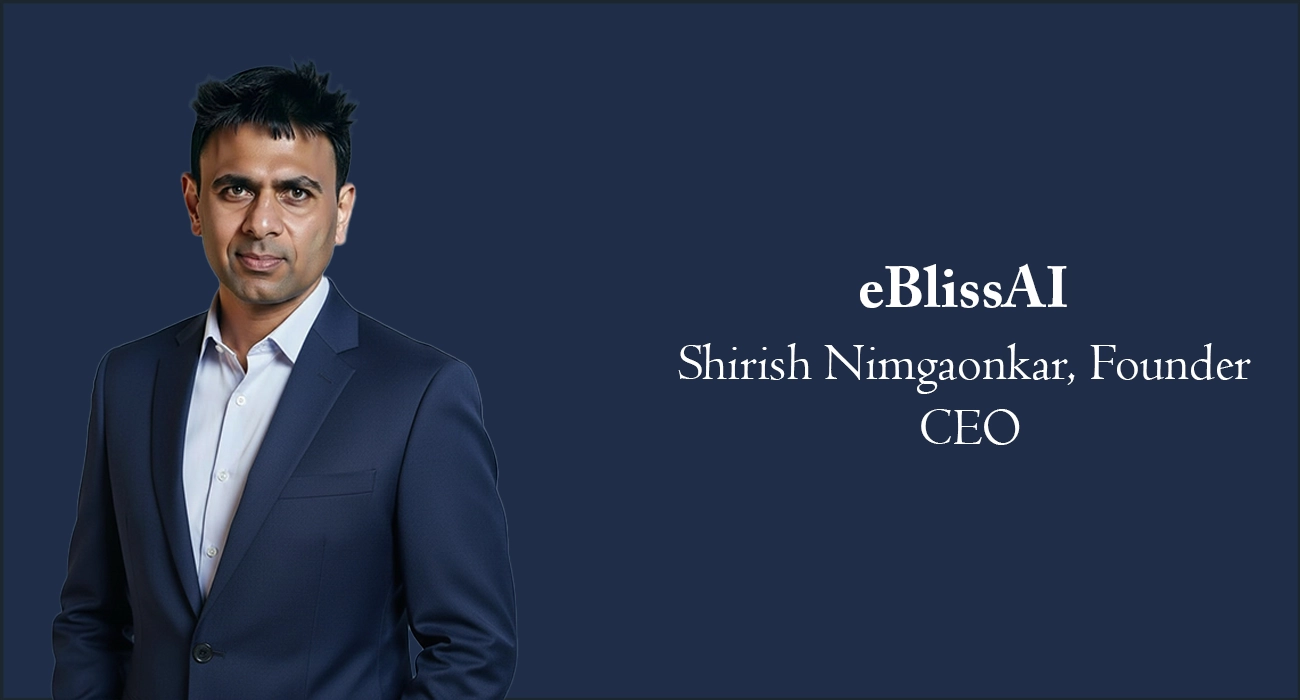
Every company that truly transforms its space starts by rejecting what everyone else accepts. That shift became clear to Shirish Nimgaonkar, founder of eBlissAI, while observing skilled IT teams spend more time reacting to alerts than building what actually matters. The system didn’t fail all at once, but it was obvious the system had reached its breaking point. By 2030, with billions of new devices coming online and layers of cloud, AI, hybrid work, and compliance stacking up, complexity kept rising. Human, on the other hand, could only stretch to a limit.
The impact shows up everywhere. Downtime costs now run into hundreds of billions each year. Teams stay under constant pressure. Burnout becomes routine, even while it’s framed as productivity. For years, enterprises have depended on tools that only show what’s going wrong, leaving people to fix everything manually.
More visibility didn’t lead to better outcomes. So the question changed. What if systems didn’t just report problems, but actually understood them? What if they could anticipate issues early and resolve them without waiting for human intervention?
That thinking led to eBlissAI, built to decouple IT capability from human labor, and to replace firefighting with foresight, reaction with prediction. Automation helps you move faster. Autonomy helps you scale.
In this exclusive interview with Business Fortune, Shirish Nimgaonkar discusses the limits of traditional automation, the rise of AI-driven autonomy, real-world enterprise impact, and how eBlissAI is helping organizations move from constant firefighting to intelligent, self-healing operations across industries.
Your academic and professional journey spans IIT Bombay, Stanford, and Harvard Business School. How did these experiences shape your thinking around autonomous computing and enterprise software? And what was it like moving from leading multiple ventures to founding eBlissAI?
Each institution contributed something distinct. IIT Bombay built discipline in me, it built the idea that excellence is not something you aim for, it’s the baseline. Stanford introduced creativity and structured experimentation. During the dot-com cycle, I saw companies rise and collapse, and learned that innovation moves in cycles, adaptability is survival, and failure often teaches more than success. Harvard added strategic empathy, the ability to understand systems, incentives, and human behavior as one interconnected whole.
But the deeper learning didn’t come from classrooms. Building and scaling ventures across the US, Europe, and Asia, along with leading global investment banking mandates, made me realize that leadership is about energy, not authority. Even Classical music taught me that structure and improvisation aren’t opposites but they’re the conditions for harmony.
The move to eBlissAI wasn’t a career shift. It was a conviction. After leading multiple VC and PE-backed companies, I saw a problem that needed first-principles thinking. Revolutions don’t start with consensus. They start with conviction. Founding eBlissAI was everything before it converging into a single, urgent, first-principles bet.
eBlissAI positions itself not just as an automation tool, but as a truly autonomous IT operations platform. In simple terms, how would you describe the difference between automation, AI, and autonomy to someone outside tech?
Think of it like driving a car. Automation is cruise control. It maintains a fixed speed until someone intervenes. It’s helpful, but limited. It only works within predefined conditions, which is why less than 5% of enterprise IT issues are actually resolved by static scripts.
AI is the next step. It’s like a co-pilot that watches what’s happening, identifies patterns, and suggests what to do next. It supports decision-making, but the human is still the one taking action. Most systems marketed as “AI” today stop here, they detect, recommend, and escalate.
Autonomy goes further. It’s a self-driving system that senses, reasons, takes action, checks the outcome, and improves over time, all within defined guardrails and with human oversight. This is what eBlissAI delivers in IT operations: detect, diagnose, resolve, predict, and continuously improve.
The difference is important because the outcomes are fundamentally different. Automation hits a ceiling. Autonomy builds momentum. Every problem eBlissAI resolves makes the system smarter and faster across all endpoints. Insight alone doesn’t change much. Autonomy is what turns intelligence into completed action.
Your platform highlights self-healing and predictive capabilities. Can you share a real customer example where the system independently resolved a critical issue and what that meant for day-to-day operations?
Think of a typical Monday morning. A sales executive is preparing for a board presentation when her key application starts crashing at launch. In a traditional setup, she raises a ticket, waits for Level 1 support, gets escalated to Level 2, and loses half the day. Now multiply that across thousands of employees, and the cost quickly becomes enormous.
eBlissAI handles it differently. It detects the crash pattern directly at the endpoint in real time, without waiting for a ticket. Using multi-agent reasoning, it identifies the root cause as a corrupted application profile, not just a surface-level symptom from logs or telemetry. From there, it follows a defined runbook: removes the corrupted configuration, restarts the application cleanly, and verifies that everything is working as expected. Every step is recorded, auditable, and reversible.
For the executive, there is no ticket and no interruption. She simply continues working, unaware that an issue was resolved in the background.
When this is scaled across an enterprise, the impact becomes significant: 25 to 60 percent fewer service tickets, 60 to 70 percent faster resolution times, and 15 to 45 times return on investment. The change is not incremental. It reshapes how IT is measured. Instead of celebrating fast recovery after failure, organizations start measuring the issues that never disrupt users in the first place.
In a world where security concerns are paramount, how does eBlissAI balance autonomous decision-making with enterprise-grade security, compliance and guardrails?
Autonomy without governance isn’t innovation, it quickly becomes risk. That’s the reason most “AI” systems in enterprise IT stop at recommendations and alerts instead of taking action. In this space, trust can’t be assumed. It has to be built into the system from the ground up.
At eBlissAI, trust isn’t treated as an add-on. It’s part of the core design. It rests on four clear principles. First is explainability. Every autonomous action, from identifying an issue to fixing it, is fully traceable and auditable. CISOs and auditors can see exactly what happened and why.
Second are guardrails. Defined runbooks, policies, and risk thresholds set clear limits on what the system can do. Anything outside those boundaries is automatically passed to a human.
Third is human-in-the-loop validation. Organizations don’t switch on autonomy blindly. They go through structured stages of discovery, ingestion, and validation before enabling full execution.
Fourth is security by design. Privacy, least-privilege access, and compliance controls are built into the platform itself, not layered on later.
The goal is simple: the CISO should feel more confident with eBlissAI in place, not more exposed. Responsible AI isn’t a slogan, it’s a series of deliberate design choices. And in the end, trust isn’t just important. It’s the foundation that turns AI adoption into real advantage.
eBlissAI works across industries ranging from healthcare to aviation. How do its benefits translate across such different environments? Are the core challenges the same, or does each sector value autonomy in its own way?
The underlying challenge is universal. IT demand is growing exponentially, while IT capacity moves in a straight line. Every industry is feeling that gap. But the impact varies widely, and that’s where tailored autonomy becomes critical.
In healthcare, even a small endpoint failure can delay a diagnosis or affect patient safety. Uptime isn’t just operational, it’s clinical quality. In aviation, a single misconfiguration can trigger cascading delays and losses worth millions within minutes. In financial services, every second of disruption carries regulatory risk. In retail, it directly affects the customer experience at the point of sale.
The core mechanics remain the same: detect, diagnose, resolve, predict and learn. But everything around it changes. Workflows, risk tolerance, compliance rules, and user contexts differ from one industry to another. eBlissAI adapts to those environments and risk profiles without requiring manual rewrites.
That’s the real difference between generic AI and enterprise-grade AI. One creates interest. The other delivers scale. Across industries, the goal is the same: technology that fades into the background so people can focus on work that truly needs human judgment.
Looking forward, what are the key innovations or capabilities in your product roadmap that excite you most, particularly in areas like edge computing, quantum-ready security, or advanced natural language interfaces?
The most exciting frontier is not a single feature. It’s about the coming together of three forces that will define the next decade of enterprise IT.
First is deeper multi-agent reasoning. We’re evolving eBlissAI’s core intelligence so that agents don’t just work in isolation. They coordinate across endpoints, cloud, networks, and applications as one connected system, instead of a collection of separate tools.
Second is what we call the predictive persona engine. The idea is simple: technology should adapt to people, not the other way around. A developer, a field engineer, and a CEO all interact with IT differently. Autonomy has to understand those differences and respond in context.
Third is a stronger layer of explainability and governance, built to match the next wave of AI regulation. That includes quantum-ready security, execution at the edge, and natural language runbooks that any operations leader can create without writing code.
If there’s a guiding belief behind all of this, it’s that the best way to lead the future is to build what the future will rely on. In five years, every enterprise will run on an autonomy layer for IT. The goal is for eBlissAI to be the most trusted, measurable, and invisible one in that stack.
Would you like us to highlight something important happening in your company that we may have missed asking about?
One theme deserves emphasis: the market is repricing legacy IT software in real time, and most boardrooms haven’t metabolized what that means. In the last few months, legacy software and SaaS stocks fell have fallen 30%–60%, while AI infrastructure stocks have risen
19%-35%. This is not macro. It is rotation. Capital is flowing out of static systems of record and into real AI capability with dynamic intelligent closed loop execution.
That signal validates what we’ve been building. Dashboards are becoming commodities; autonomous execution is becoming the moat. The CIO role has been elevated to the board level precisely because the business case for AI is now existential, not experimental.
eBlissAI is not another IT tool. It is the autonomous layer for modern IT operations starting with partial autonomy today, with a clear path to full autonomy. We are hiring aggressively, expanding across APAC, North America, and Europe, and deepening partnerships with global SIs, OEMs, and MSPs. The future belongs to systems that elevate human potential and create everyday moments of digital bliss.
Executive Bio of Shirish Nimgaonkar, Founder and CEO of eBlissAI
Shirish Nimgaonkar is the Founder and CEO of eBlissAI, where he is building predictive autonomy for enterprise IT. An alumnus of IIT Bombay, Stanford University, and Harvard Business School, he brings together deep expertise in technology, strategy, and design.
A serial entrepreneur with successful exits across VC and PE-backed ventures, he has scaled high-growth technology companies across the US, Europe, and Asia, with experience spanning enterprise software, AI-driven automation, and global investment banking.
Beyond business, he serves as Entrepreneur in Residence at Harvard Business School and has been a Board Member at TiE Boston, actively mentoring founders. A trained classical musician and fusion band lead singer, he also supports initiatives in education, healthcare, and women’s empowerment.
His guiding belief: the most powerful technology is the one you don’t notice, quietly working in the background to amplify human potential and create everyday moments of digital clarity and ease


.webp)