Business Fortune

Early detection is one of the most powerful tools in the fight against cancer—yet for millions, diagnosis still comes too late. As healthcare leaps forward, the focus has shifted to technologies that uncover disease sooner, with greater precision and less strain on patients. At the heart of this evolution lies a new wave of diagnostics, where liquid biopsy emerges as a transformative force. Leading this charge with brilliance and compassion is Creatv MicroTech, Inc., a company reshaping the landscape of cancer detection.
Blending deep expertise in diagnostics and microfabrication, Creatv MicroTech has developed the revolutionary CellSieve™ microfilters—micro-scale tools that form the foundation of LifeTracDx®, the company’s advanced liquid biopsy platform. This non-invasive blood test isolates all cancer-associated cells, enabling early detection, precise diagnosis, and real-time monitoring of treatment response.
Through its focused division, Creatv Bio, the company has made groundbreaking discoveries, including the identification of Cancer-Associated Macrophage-Like cells (CAMLs)—a biomarker uniquely found in cancer patients. This scientific leap has unlocked wide-ranging clinical applications, from cancer screening to cancer diagnostics.
At Business Fortune, we had the distinct honor of interviewing Dr. Cha-Mei Tang, President and CEO of Creatv MicroTech, Inc. She shared compelling insights into how she and her team of expert scientists are revolutionizing cancer diagnostics—driven by a mission to save lives through early, accurate detection.
From Microfabrication to Life-Saving Diagnostics: The Genesis of Creatv MicroTech, Inc.
Creatv MicroTech, Inc. is a rising force in cancer diagnostics—but its origin was anything but courageous. At the center of this journey is Dr. Cha-Mei Tang, a scientist driven by relentless curiosity and a passion for innovation.
“I have always been curious about all aspects of science, life, and business,” says Dr. Tang. After a successful career at the Naval Research Laboratory working on free electron lasers, relativistic electron beams, and other advanced technologies, Dr. Tang saw an opportunity to leave government service. In 1996, she founded Creatv MicroTech, initially focusing on microfabrication of x-ray antiscatter grids to improve imaging.
“In 2000, I broadened the vision for the company to also perform research on bio-detection of pathogens and medical applications and reincorporated the company in Delaware,” she shares. Since 2010, the company has focused on developing blood tests for cancer screening and diagnostics—leveraging its core strength in microfabrication.
But the real turning point came unexpectedly. “The venture into cancer diagnostics was accidental,” Dr. Tang explains. A researcher had asked Creatv to develop a filter for collecting circulating tumor cells (CTCs) from blood samples, with 7–8 micron pores across 180,000 pores in a 9 mm diameter area. “By the time we finished developing the microfabricated filters, he decided to use another supplier because we took too long. So we decided to use the filters and called them CellSieve™ microfilters.”
That decision launched a surprising path. “Building a healthcare company happened accidentally. We started research and development to demonstrate the CellSieve™ microfilters’ capability by capturing CTCs from cancer patient blood. In our first sample, we found a lot of strange-looking giant cells. We couldn’t find any clinical references to them. Our pathologist advised us to analyze them carefully.”
She elaborates: “CTCs are tumor cells that break free from tumors and enter the bloodstream. They’re typically 10–20 microns in size and express cytokeratin (CK). CK in live CTCs has filamented structures, while CK in dead CTCs appears as dots (Figure 1).”
Creatv scientist Daniel L. Adams conducted a detailed analysis of the giant cells. “He showed they express macrophage markers. We named them Cancer-Associated Macrophage-like Cells (CAMLs) and published the findings in PNAS in 2014.”
Dr. Tang continues, “CAMLs are very large—typically 25–300 microns in size (Figure 2). They’re polynucleated from engulfing many tumor cells. Smaller ones are round or oval; larger ones are rod-shaped. Some have one or two tails, which can be very long. We’ve processed blood from over 30 different tumor types and found CAMLs in all of them—including stage 1 cases. However, we haven’t observed CAMLs in healthy controls.”
“In the last 2–3 years, other researchers began publishing on CAMLs, independently validating our findings,” she adds. “In most of the publications, they call these cells by different names.”
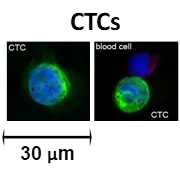
Figure 1. Images of Circulating Tumor Cells (CTCs). The dark blue represents the fluorescent image of the nucleus, while the green filaments indicate cytokeratin conjugated with green fluorescent dyes. In live CTCs, cytokeratins appear as filaments, whereas in dead CTCs, they appear as dots.
.webp)
Figure 2. Images of Cancer-Associated Macrophage-like Cells (CAMLs). The white arrow points to a white blood cell (WBC). CAMLs typically range from 25 to 300 microns in size. They are polynucleated (dark blue) as a result of engulfing multiple tumor cells. When small, they are round or oval in shape. They are sometimes found as large rod shapes and often have one or two tails on opposite sides. These tails can be very long.
LifeTracDx®: Transforming Cancer Diagnostics and Empowering Drug Development
From a surprising discovery to a revolutionary diagnostic tool, Creatv MicroTech’s journey reflects years of scientific persistence and innovation. At the heart of this progress is the LifeTracDx® blood test, a powerful advancement in personalized cancer care.
“Our LifeTracDx® blood test is scientifically groundbreaking, because Creatv Bio is the first to publish on the clinical utility of the funny-looking CAMLs we found in the blood of cancer patients,” says Dr. Tang. “Creatv Bio scientists spent more than 10 years researching the clinical applications of those cells.”
Applicable across all cancer types and stages—including solid tumors and blood cancers—LifeTracDx® is designed for both screening and diagnostics. “Currently, we are more focused on cancer diagnostics applications benefiting the cancer patients under treatment,” Dr. Tang adds.
Dr. Tang highlights its core benefits:
- “LifeTracDx® can determine if the patient is responding to a new therapy in about 30 days, so patients won’t waste time on ineffective treatment while waiting for imaging to confirm tumor progression.”
- “Many approved and experimental therapies target specific tumor markers. Companion diagnostics typically require tumor tissue, which can be costly and hard to acquire repeatedly. LifeTracDx® offers a blood-based alternative, including PD-L1 testing to assess immunotherapy suitability.”
- “It can assess cancer aggressiveness—for instance, a CAML larger than 50 microns indicates a poor prognosis.”
- “The test allows continuous monitoring of treatment response, even as tumor markers evolve, often revealing insights not visible through imaging.”
- “It yields numerous copies of unfragmented tumor DNA from CAMLs, superior to ctDNA fragments, for identifying mutations, amplifications, and deletions.”
In addition to diagnostics, LifeTracDx® plays a vital role in drug development and clinical trials.
“We help cancer drug companies understand the effectiveness of their drug and develop companion diagnostics. LifeTracDx® can predict treatment response,” says Dr. Tang.
One example is a clinical trial with BriaCell Therapeutics Corporation (Philadelphia, PA), involving metastatic breast cancer patients treated with a cancer vaccine and immunotherapy. “Their data, presented at the San Antonio Breast Cancer Symposium (SABCS) in December 2024, showed that a decrease in CTCs/CAMLs correlated with better Progression Free Survival and trended toward better Overall Survival,” she explains. “The therapy also appeared to upregulate PD-L1 in 15 patients, correlating with improved responses to immunotherapy.”
For more information, you can view the data presented at SABCS 2024 here: https://creatvbio.com/posters
Dr. Cha-Mei Tang’s Mission: Redefining Cancer Diagnostics with LifeTracDx®
Dr. Cha-Mei Tang, President and CEO of Creatv MicroTech, Inc., is on a mission to change the way cancer is detected and monitored. Her drive comes from a sobering truth:
“It is sad to say that ~40% of Americans will develop cancer in their lifetime. In the U.S., cancer is the second leading cause of death, and its incidence is rising,” says Dr. Tang.
While many companies offer cancer screening, most technologies are limited in scope. “One company, Grail, has a blood test for 50 types of cancer, but it can’t detect major cancers like breast, prostate, or kidney in Stage I,” she explains. “Our LifeTracDx® test can detect those early-stage cancers most of the time.”
What sets LifeTracDx® apart is its ability to provide timely and actionable insights. “Our test gives oncologists vital information: How aggressive is the cancer? Is therapy working? Has the tumor changed? Continuous monitoring is crucial—it guides treatment adjustments that can save lives.”
One area where LifeTracDx® shines is in tracking immunotherapy response. “Immunotherapies enable T-cells to kill tumors, but only work if the PD-L1 marker is highly expressed. The challenge is, PD-L1 expression often changes over time,” she explains.
Traditionally, PD-L1 testing requires invasive tissue samples, which can’t be easily repeated. “In our trials, we’ve seen patients shift from low to high PD-L1, and then respond well to immunotherapy. That’s where our blood test becomes invaluable.”
Despite the benefits, immunotherapy isn’t given to everyone—mainly due to high costs. “Some drugs cost $100,000 to $250,000 a year,” she notes. “We help oncologists determine if immunotherapy is a viable option, based on real-time tumor biology.”
LifeTracDx® offers a non-invasive, repeatable way to monitor PD-L1 and other markers. “It helps doctors know if treatment is working or if it’s time to consider alternatives,” she adds. “Our goal is to provide that critical information in time to make a difference.”
Breaking into the market hasn’t been easy. “DNA and RNA markers are well accepted, so it's hard to gain attention. But we’re focused on spreading awareness through science.”
Creatv Bio’s credibility is grounded in data. “We have 29 journal publications and more under review. We’ve also presented at major conferences like AACR and ASCO.”
With LifeTracDx®, Dr. Tang and her team are not just creating a diagnostic test—they’re empowering oncologists to make faster, better decisions. “We want to save and improve lives all over the world.”
The Road Ahead
As Creatv MicroTech continues to reshape the cancer diagnostics space, Dr. Cha-Mei Tang is focused on ensuring their revolutionary blood test, LifeTracDx®, receives the attention and validation it deserves—both in the scientific community and in the broader market.
“Our LifeTracDx® blood test will disrupt the current diagnostic landscape,” says Dr. Tang. However, she acknowledges the challenge: “Testing of DNA and RNA as cancer markers is well accepted, so it's hard for LifeTracDx® to enter the market when most people haven’t heard about it.”
To address this, the company has committed itself to rigorous scientific dissemination. “We are spreading the information scientifically. We already have 29 journal publications and more under review,” she adds, referring to a growing body of peer-reviewed evidence backing their innovation (Journal Publications). Creatv has also presented numerous posters at major cancer conferences like the AACR and ASCO, further reinforcing the credibility of their work (Conference Posters).
Looking ahead, Creatv is preparing for a pivotal next step—opening its own CLIA-certified lab in Monmouth Junction, New Jersey. “We are excited that we will be launching our CLIA lab so that we can process patient samples from the general public,” Dr. Tang shares. This facility will not only expand access to LifeTracDx® but also solidify its clinical presence.
The company is also preparing three FDA applications that promise to further distinguish LifeTracDx® from traditional diagnostics:
- A blood test to predict treatment response within 30 days of therapy,
- An assessment of cancer aggressiveness, and
- A companion diagnostic for PD-L1 expression using a simple blood test to determine a patient’s potential response to immunotherapy.
Dr. Tang affirms, “We will further expand the number of FDA applications in the future.”
And beyond scientific achievements and regulatory milestones, Creatv MicroTech is zeroing in on a critical piece of the puzzle: insurance reimbursement. “Paramount to driving growth and revenue is to obtain reimbursement for the LifeTracDx® blood test. The first goal is to get reimbursement from the CMS, then approach various private insurance payers,” concludes Dr. Cha-Mei Tang.
Meet the Visionary Upfront
Dr. Cha-Mei Tang is the Founder, President, and CEO of Creatv MicroTech, Inc. She earned all her degrees—BS, MS, and ScD (equivalent to a PhD)—from the Massachusetts Institute of Technology.
She worked at the Naval Research Laboratory, focusing on theoretical physics and specializing in free electron lasers and relativistic electron beams. There, she served as Head of the Radiation and Accelerator Physics Section in the Plasma Physics Division. In 1996, she founded Creatv MicroTech in Maryland, initially developing an X-ray antiscatter grid to enhance X-ray imaging. In 2000, she reincorporated the company in Delaware, expanding its scope to encompass a broad spectrum of biomedical research.