Business Fortune
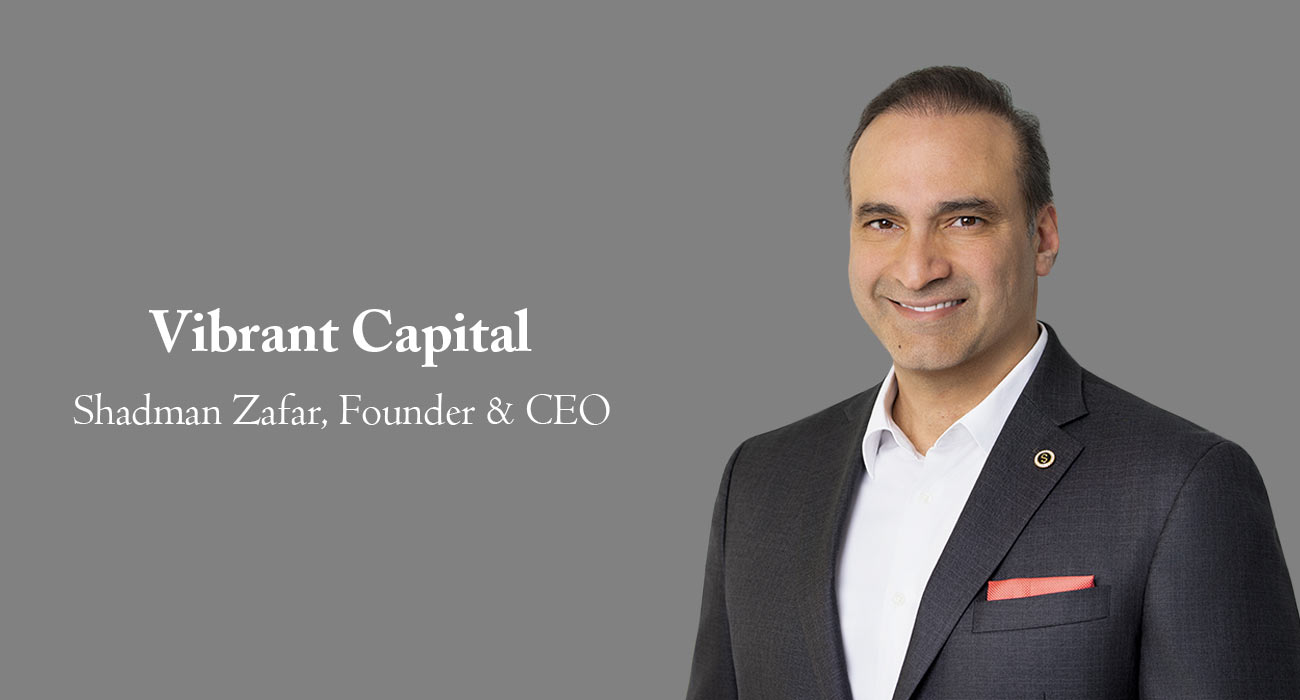
Shadman Zafar describes this moment as the Third Wave of AI, where artificial intelligence must move beyond experimentation and prove its ability to create measurable business value. The first wave introduced algorithms and academic breakthroughs, while the second built the data and cloud infrastructure needed to scale them. Today’s challenge is turning AI into a driver of real-world outcomes. Drawing from lessons of past AI winters, Shadman recognized the gap between executive enthusiasm and the lack of measurable impact within industries such as banking, healthcare, and supply chains.
Through Vibrant Capital, he aims to bridge that divide by placing operators at the center of AI innovation and helping organizations adopt trusted, outcome-driven solutions. He believes the biggest challenge is not the technology itself, but the operational foundations around it, including data quality, accountability, governance, compliance, and security. Vibrant Capital addresses this challenge by investing in solutions built around verified business needs, rigorous CIO-led evaluations, and close collaboration between enterprise leaders and technology builders from the earliest stages.
Business Fortune spoke exclusively with Shadman Zafar, CEO of Vibrant Capital, about how the company is accelerating enterprise AI adoption by investing in trusted, operator-driven solutions that deliver measurable business impact. Through its AI-focused approach, Vibrant Capital is helping organizations build scalable, secure, and AI-native operations across regulated industries.
Interview Highlights
Vibrant Capital emphasizes that “the most important thing about AI is not intelligence, but trust.” As AI becomes increasingly embedded in business-critical operations, how do you see enterprise expectations around trust, auditability, and explainability evolving?
The bar is rising from simply asking, “Is the answer right?” to demanding, “Can you show your work, on demand, to someone determined to poke holes in it?” I think about this in terms of three commitments. The first is maintaining a clear record of how a system was built and which data shaped it. The second is the ability to replay any consequential decision and explain, step by step, how it was reached after the fact. The third is maintaining a standing body of evidence through test cases and validation results that demonstrate the system performs reliably under messy, real world conditions, not just in controlled demos. Auditability and explainability are no longer nice-to-have features. They are becoming hard procurement requirements. These are among the areas where we invest most actively. Solve trust, and scale finally becomes possible.
Your platform focuses on regulated and data-rich industries like banking, healthcare, and manufacturing. Which of these sectors is undergoing the most meaningful AI-driven reinvention today, and why?
Financial services is moving the fastest because dense, high-quality data and regulatory pressure require precision. Institutions cannot afford mistakes in areas like KYC, fraud detection, or claims processing, which is why the leaders are building real AI foundations rather than relying on concepts. Our portfolio includes companies like PerceptaCore, which is modernizing KYC through AI agents that deliver meaningful business impact. However, healthcare holds the greatest untapped potential. Operational challenges, from departmental handoffs to claims delays and clinical information access, create opportunities for embedded intelligence to improve efficiency and patient outcomes. Financial services is transforming visibly today, but healthcare may be the biggest opportunity ahead, followed by manufacturing, where predictive optimization is reshaping factories and supply chains.
Your leadership team brings decades of experience from organizations such as Citi, JPMorgan Chase, Barclays, and Verizon. How does this real-world operating experience influence your investment decisions and differentiate Vibrant Capital from traditional private equity and venture investment firms?
Our team didn’t study enterprise transformation from the sidelines. We were accountable for delivering it at Fortune 100 companies under the scrutiny of boards, regulators, and shareholders. When your decisions are tested at that level, you learn a fundamental truth: intentions mean nothing unless they’re backed by measurable results and airtight controls.
That experience shapes how we evaluate companies. A polished demo doesn’t impress us. We ask whether a business can withstand the realities of a regulated enterprise, including governance, scalability, operational resilience, and demonstrable business impact.
It’s also what distinguishes us from a traditional private equity or venture capital firm. We don’t spread small investments across hundreds of companies, hoping one becomes a breakout success. Instead, our operators identify genuine gaps in enterprise demand, we find or build the company best positioned to fill them, and those same leaders become its earliest customers, design partners, and advocates. That kind of validation, coming directly from the executives who make enterprise buying decisions, is something a conventional investment firm simply cannot manufacture.
You also work closely with CIOs and tech leaders through your network and advisory work. What are the main concerns you hear from them about adopting AI, and how are those concerns influencing how AI products and solutions are being built?
The complaint I hear most often is exhaustion from trying to figure out what’s real. Because anyone can now spin up something that looks intelligent, CIOs are buried under a flood of thin products, many of which are little more than polished shells built on someone else’s model. The resulting clutter makes every genuine breakthrough harder to recognize and trust. Beneath that lie the more enduring concerns: security exposure, vendor lock-in, and, above all, proof that a solution actually delivered results.
They’re tired of being shown headcount reductions and login statistics when what they really need is evidence that a meaningful business metric moved. Those frustrations shape how we counsel founders: anchor your story in the outcome the buyer actually cares about, and invest in how you represent, manage, and apply the enterprise’s own data rather than simply renting access to a frontier model. We’re now turning that operator wisdom into a practitioner-built standard that defines what must be true before an enterprise is willing to consider a company ready for adoption.
The AI market is crowded with new tools, platforms, and emerging technologies. How do you identify companies that can deliver sustainable enterprise value rather than short-term hype, and what characteristics define a truly transformative Applied AI business?
My first filter is a phrase I repeat often: fall in love with the problem, not the solution. Enterprise AI requires more than a slick demo; it demands governance, scalability, and measurable business value. The real challenge lies in data. Simply applying a frontier model and an agent to customer data creates a limited impact. The companies that succeed combine specialized models for specific workflows, mid-sized models for coordination, and frontier models used strategically to connect the system. The key question is whether a product makes an organization genuinely more intelligent, not just faster. Lasting adoption, not short-term excitement, proves true transformation.
How will emerging trends reshape enterprise transformation, and how is Vibrant Capital enabling the rise of AI-native organizations?
The defining change is AI graduating from a tool that drafts text to a force that takes action: autonomous systems embedded into live operations, reducing handoffs, continuously monitoring compliance, and reallocating resources as conditions evolve. The technologies enabling this shift, including agent orchestration, emerging context standards, and compact models fine-tuned on a company’s own data, are compounding into gains that may seem understated today but will prove significant over time.
In the near term, the biggest opportunity lies in operational efficiency. Over the longer term, the frontier I find most exciting is one that receives far less attention: unleashing AI on the growth side of the business. Imagine generating hundreds of strategic hypotheses, testing them against simulated customer environments, and bringing only the strongest one or two ideas to market.
I would also point to Jevons Paradox: as software development becomes dramatically cheaper, demand for software is likely to expand rather than decline. We could move from a world with tens of millions of software engineers to one approaching a billion people creating software, though the nature of that work will look fundamentally different from today’s coding.
To build the foundation for AI-native organizations, we are introducing two operator-authored standards: the CIO Readiness Index and a Reference Enterprise Architecture for the post-AI era. The goal is to ensure that the leaders responsible for operating these systems help define the blueprint rather than simply inherit one.
Under The Leadership of Shadman Zafar
Shadman Zafar is a globally recognized technology leader and prolific inventor who has spent decades driving digital transformation at Fortune 100 companies. He has held executive leadership roles at Citigroup, JPMorgan Chase, Barclays, and Verizon, serving as CIO, Chief Digital Officer, and Chief Product Officer.
Throughout his career, Shadman has built award-winning technology products used by millions and scaled platforms supporting more than 100 million customers. He is also the holder of over 100 patents spanning finance, telecommunications, entertainment, technology, and design. Today, as CEO of Vibrant Capital, Shadman is leading the effort to bring the power of AI to Main Street and accelerate its adoption across businesses and communities.


.webp)