20 Most Innovative Companies 2023
Business Fortune
A legacy system is an old or out-dated system, technology or software application that continues to be used by an organization because it still performs the functions it was initially intended to do. Generally, legacy systems no longer have support and maintenance and they are limited in terms of growth. In order to adapt to all these changes, IT systems are constantly evolving as well.
Most often, vendors can handle integrations well except for this critical, complex part of the process - legacy systems. Yet most established organizations rely on legacy technology to run their business. OpenLegacy has found a way to do these integrations far faster than any other current method so companies can be agile and innovative today and more easily migrate off the legacy system in the future. It’s a solution for today - and tomorrow.
Most inventive solutions OpenLegacy provides its clientele
Financial Services Challenges:
- Improve the customer experience: Provide faster service access, enabling seamless Omni channel interactions, offering personalized services, enhancing security and compliance measures, and facilitating real-time data access
- Meet new compliance and regulatory requirements (Open Banking, GDPR, and CCPA): Include data with pre-configured API specs from complex and hard-to-reach structures like VSAM, IMS, CICS, and other legacy systems. Ensures compatibility with modern platforms, real-time data access, efficient audit trails, and implements consent management mechanisms
- Scalability and innovation: Auto generate micro service-based APIs in a cloud native manner using tools such as CLI for a continuous modernization practice of a digital factory, enabling organizations to innovate at scale without being held back by their current infrastructure
Manufacturing Challenges:
- Improved vendor experience and streamlined workflows: Provide faster service access, enabling seamless interactions, offering personalized services, enhancing security and compliance measures, and facilitating real-time data access
- Fully capable digital and mobile inventory: Enables the transformation of traditional inventory systems into digital interfaces that empower the workforce on the go. By integrating with existing systems, the systems of tomorrow can be a reality today
- Smart manufacturing and predictive maintenance: Empower manufacturers to implement predictive maintenance by combining historical and real-time equipment data, optimizing operational efficiency. Enriches datasets by unifying old and new equipment sources, leading to accurate insights
- AI, ML, and IoT enablement: With over 75% of an organization’s data and processes residing in legacy systems, OpenLegacy enriches, enhances, and unlocks AI, ML, and IoT enablement to deliver the most comprehensive solutions
- Scalability and innovation: Auto generate micro service-based APIs in a cloud native manner using tools such as CLI for a continuous modernization practice of a digital factory, enabling organizations to innovate at scale without being held back by their current infrastructure
Mainframe Challenges:
- Monolithic architecture: Difficulty migrating from monolithic mainframe applications to modern microservices architectures. The languages and approaches are very different making integration and communication complex
- Reliance on middleware: Reliance on complex middleware for connections. Traditional middleware creates performance bottlenecks and maintenance headaches compared to more modern integration approaches
- Complex and hard to reach data sources: Accessing and extracting data from legacy mainframe data sources like VSAM files. This is a manual, time-consuming process but that data needs to be leveraged for things like regulatory compliance
IBM I/AS400 Challenges:
- Integration with Modern Technologies: As businesses expand and adopt modern technologies, there's a need to integrate IBM i systems with newer platforms, applications, and APIs. Ensuring seamless data exchange between IBM i and other systems, such as cloud-based solutions, can be a complex task
- Legacy Technology and Skill Gap: Many businesses have been using IBM i systems for decades, relaying on legacy technology and outdated programming languages like RPG and COBOL. There is a shortage of skilled professionals who are proficient in these older technologies, making it challenging to maintain and evolve these systems
- User Interface and User Experience: Legacy IBM i applications often have outdated and less user-friendly interfaces, which can lead to decreased productivity and user satisfaction. Modernizing the user interface and improving the overall user experience is crucial to keep employees engaged and efficient
Databases Challenges:
- Lack of agility: Legacy databases were designed with older hardware limitations, making it challenging to scale them to meet growing data demands. This can result in performance bottlenecks and reduced efficiency as an organization's data needs increase
- Integration complexity: Legacy systems often use outdated hardware and software, leading to compatibility issues with modern applications and tools. This can hinder system integration and data exchange, making it difficult to leverage new technologies
- Data migration: Transitioning data from a legacy database to a modern system can be complex and error-prone. Legacy databases often have unique data structures and format that need to be converted, which can lead to data loss or corruption risk
Meet the leader behind the success of OpenLegacy
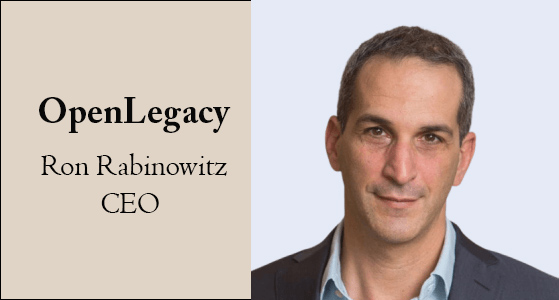
Ron Rabinowitz, Chief Executive Officer
As OpenLegacy’s CEO, Ron oversees global financial operations, strategy, investments, and reporting, staffing, and overall business operations. Ron brings 15 years of experience across various local, regional and global management roles at P&G and served as CEO of a P&G Joint Venture company, acquiring ample experience with the technology startup ecosystem, including financing, large-scale commercial and investment transactions, IP, etc. Ron was part of the team leading P&G’s divestiture of the Duracell business and joined OpenLegacy after completing the transition year with Berkshire Hathaway. Ron holds L.L.B and B.A in management degrees, with the highest distinction, from Tel Aviv University.


.webp)