30 Most Innovative Companies of the Year 2024
Business Fortune
5G has become the industry standard for mobile communications technology, ushering in a transformative era of connectivity, speed, and endless possibilities. With up to 1,000 times more bandwidth and a potential 100-fold increase in mobile network speeds, the future of mobile services holds immense promise.
It seems that consumers and businesses are on the verge of having everything: high-speed connections, minimal latency, ultra-reliability, extensive capacity, and low energy consumption. The impact of 5G is connecting businesses, individuals, and operations on an unprecedented scale. Presently, telecommunications companies are crafting innovative business strategies to monetize their investment in 5G infrastructure.
Digital Global Systems (DGS) harnesses the power of 5G to help businesses transform their operations and create new sources of income for telecommunications companies. DGS offers a cutting-edge software platform for wireless deployments that delivers a comprehensive analysis of the radio frequency environment from multiple perspectives. With an extensive portfolio of patented technologies, DGS is well-equipped to drive innovation and enhancement in the wireless spectrum.
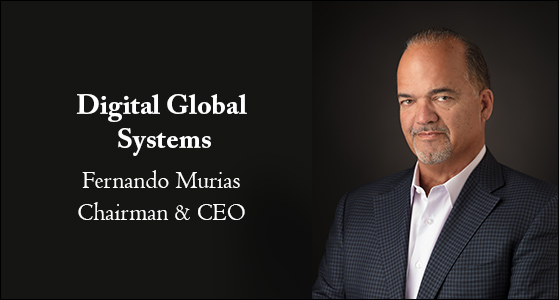
Business Fortune sat down for a conversation with Fernando Murias, Chairman and CEO of Digital Global Systems. The following excerpts have been taken from the conversation that ensued
Q. How did Digital Global Systems start? How has the company grown since its foundation?
DGS was founded in 2013 with the intention of simplifying wireless spectrum management. Until now, telecom companies, government agencies, and businesses have had to use spectrum analyzers, and each one needs a trained RF (Radio Frequency) engineer to understand the results. We saw a way to utilize distributed computing to analyze the spectrum, find anomalies such as interference or degraded performance at the point of intercept, and report this to stakeholders in layman’s terms. Since then, we’ve expanded on this capability to provide automated spectrum optimization by providing real-time RF awareness data to network infrastructure components, allowing them to pack the wireless spectrum more densely without increasing interference.
Our patented technology is the foundation for dynamic spectrum sharing, a key pillar in the 2023 National Spectrum Strategy released by the White House. With over 200 patents, we’re at the forefront of utilizing advanced machine learning and AI to optimize spectrum and enable new revenue-generating services autonomously.
Q. Why did you choose to start a company in the wireless deployment of radio frequency environments? How did you find the scope to innovate in this market?
We saw the complexity of using spectrum analyzers and the cost of highly skilled RF engineers as a hurdle to the expected growth in wireless devices. Other companies were trying to automate spectrum management by placing unintelligent sensors at the network edge and sending huge volumes of data to a data center to be sifted through. We took a different approach by using the lower cost of computing power to analyze the RF environment at the point of intercept and providing usable knowledge to stakeholders in terms they could use to improve their business operations. Our R&D staff is comprised of several PhDs and experts in both RF and AI.
Q. Did you realize how big the market for software products in the telecommunications sector was when you started the company?
When we started DGS, we were narrowly focused on solving specific problems for wireless carriers. We quickly realized that, with the explosion in wireless device deployments caused by LTE and 5G, the finite RF spectrum was going to become too congested to manage with traditional approaches. We predicted the move to dynamic spectrum sharing, where multiple services can co-exist at the same frequency, much earlier than our competitors, and began building the technology and a patent portfolio to support this.
As it turns out, our prediction was correct. Last year, the White House released the National Spectrum Strategy, which requires dynamic spectrum sharing as a fundamental concept. We are now years ahead of our competition, with a patent moat around AI-enabled dynamic spectrum sharing.
Q. What are the different types of solutions offered by Digital Global Systems?
AI-enabled spectrum optimization and dynamic spectrum sharing are key components of our offering. We’re now working with several RAN vendors to embed our software into their hardware.
Our RF Environmental Awareness technology also allows us to provide a security solution where we detect anomalous signals and can classify and geo-locate those that pose a threat, including drones, jammers, and unauthorized mobile devices.
Q. How important is innovation for the company? What steps has the company taken to promote and nurture innovation within its team?
Our mission at DGS is to pioneer innovation through the power of AI, revolutionizing spectrum optimization for enhanced connectivity worldwide. We are dedicated to fostering collaboration, leveraging customer feedback as our compass to steer development efforts, and promoting open communications to drive meaningful advancements in technology and connectivity. We strive to work as a team and minimize silos, which tend to form naturally when people are innovating. Our goal is to ensure everyone feels they have a voice.
Q. What part has innovation contributed to the company’s growth?
Our CTO, Armando Montalvo, is an industry-recognized leader in wireless communications. He earned his Ph.D. from Stanford University at an early age and worked with industry giants at Bell Labs, Alcatel-Lucent, Hughes Satellite, and others. Today, he participates as a subject-matter expert on several government and industry committees that help shape policy for spectrum allocation, spectrum optimization, and dynamic spectrum sharing. His insights have proven invaluable in guiding our long-term technical strategy and building our patent portfolio.
Our focus is on strategically expanding R&D efforts and constantly pushing the boundaries of our technology platform. This ensures that DGS remains at the forefront of the wireless industry, offering cutting-edge solutions to address emerging challenges.
Q. How have Digital Global Systems’ innovative patented technologies revolutionized the way today’s networks are optimized?
We now have 200 issued patents and have expanded our coverage to new industries as satellite and suborbital devices become more prevalent in real-time communications. We have also seen an expansion of our technology into more government-oriented opportunities as border security and drone warfare become more prevalent. One of the pillars of the National Spectrum Strategy released last year is a focus on dynamic spectrum sharing. We anticipate additional licensing opportunities as more companies rush to implement dynamic spectrum-sharing solutions because we’ve been anticipating this move and building technology to support it, along with a patent portfolio to protect it. Lastly, since we have been focused on using machine learning and AI since 2013, we have a market-leading patent position on the use of enhanced RF awareness to drive AI solutions to maximize spectrum utilization.
Q. What are Digital Global Systems’ plans for the future?
Although we just moved out of R&D and into our commercialization phase, we are partnering with some outstanding global brands and expect to reach $1 billion in revenue in the next 5 years as we are a critical component of the new digital economy.
Meet the Chairman and CEO
Fernando Murias serves as the Chairman and CEO of Digital Global Systems. After departing from PwC as the managing partner of the Washington, DC, office, he spearheaded the business plan and capital raise strategy upon joining DGS. Under his leadership, the engineering capabilities were expanded, and the organizational structure was enhanced. Notably, he successfully secured $100 million to fuel an extensive R&D initiative aimed at creating a leading patent portfolio in spectrum management on a global scale.
He predicted that spectrum usage would outgrow communication network infrastructure. Originally designed to automate tasks like interference management, DGS now offers comprehensive spectrum monitoring and optimization through advanced AI. This aligns with 5G, dynamic spectrum sharing, and emerging wireless services.


.webp)