Business Fortune
RNA as a therapeutic modality has arrived on a global scale with new medicines approved for rare disease and as vaccines. This is only the beginning. Everyone will face a genetic condition in their lifetime. And, because RNA therapies can be programmed to precisely target genetic causes, the company can conceive of addressing most genetic conditions. Finding therapies requires mining RNA biology data. But, this data is vast, complex and overwhelming, making standard approaches to drug discovery too slow and costly.
Deep Genomics has the solution. The AI Workbench untangles the complexity in RNA biology, identifies novel targets, and evaluates thousands of possibilities to identify the best therapeutic candidates. The company seeks to program therapies for any gene and any genetic condition. Deep Genomics has over 100 team members, with expertise in artificial intelligence, automation, cell and molecular biology, clinical development, in vitro disease models, machine learning, medicine, molecular genetics, preclinical development, organic chemistry, and software engineering. Deep Genomics recruits from among the top 1% of recent graduates and seasoned experts at the intersection of genomics, drug development and AI.
Intelligent approaches Deep Genomics uses
AI-Powered Discovery: The future of drug development will rely on artificial intelligence, because biology is too complex for humans to understand
RNA as a therapeutic modality has arrived on a global scale with new medicines approved for rare disease and as vaccines. This is only the beginning. Everyone will face a genetic condition in their lifetime. And, because RNA therapies can be programmed to precisely target genetic causes, Deep Genomics can conceive of addressing most genetic conditions. Finding therapies requires mining RNA biology data. But, this data is vast, complex and overwhelming, making standard approaches to drug discovery too slow and costly.
DG’s proprietary AI Workbench is designed for data-driven prediction, positive feedback loops, and exponential growth. It enables the company to identify leads for over 50% of the novel targets Deep Genomics select, and to do so quickly. This is a game changer.
In 2018, DG’s proprietary AI Workbench unlocked the first targets in which RNA splicing was the defect and the mechanism for correction. The AI Workbench 2.0, released in the spring 2020, expanded the number of mechanisms for increased expression. This work generated over 10 program opportunities for internal and partnered development.
Deep Genomics are currently developing AI Workbench 3.0, which will expand the number of mechanisms and genetic variants the company can pursue. This includes expanding into more complex genetic diseases. As genetic targets are less understood in complex genetic disease, the AI Workbench will play an even greater role in identifying novel targets, as well as therapies, to modulate disease. The company is now pursuing these programs internally and through partnerships.
The Proprietary AI platforms at Deep Genomics consist of datasets, data processing pipelines, machine learning systems, including foundation models and large language models, and software engineering systems, plus the processes and protocols followed by team members.
In the AI community, a foundation model is a very large machine learning model that can be used for a wide range of tasks. In drug discovery, a traditional AI model may be good at one task, such as predicting molecule-target interactions, whereas a foundation model will have learned fundamental aspects of biology and chemistry that benefit many tasks.
This means that BigRNA can uniquely discover a wide range of new biological mechanisms and RNA therapeutic candidates that would not be found using traditional approaches. The company has built, and continues to improve upon, the proprietary BigRNA platform, which is fueled by diverse proprietary datasets, new ML engineering advances, and the ongoing work of the scientists.
Currently, most efforts have focused on predicting data that measures overall gene expression levels, which are not suited to predicting regulatory interventions; for example, specific transcriptional perturbations on splicing or polyadenylation. In contrast, BigRNA is trained to predict RNA expression at sub-gene resolution.
The BigRNA model is good at target identification, discovering novel biological mechanisms that can be drugged, predicting molecule-target interactions, designing therapeutic candidates, designing surrogate molecules for in vivo testing, and much more. Further, it can do all of this across a wide range of species, tissues, cell models, and RNA therapeutic modalities, including oligonucleotides, DNA editing, RNA editing, and mRNA. For some of these tasks, there are individual tools, such as Enformer, Saluki, or SpliceAI, but the company found that BigRNA exceeds the state of the art across a wide range of tasks.
GenomeKit: GenomeKit is the in-house Python solution for fast and easy access to genomic resources such as sequence, data tracks, and annotations. GenomeKit is also designed to work with genome variants, giving users a powerful way to extract features for different genotypes. The goal is to let machine learning researchers build data sets easily and allow creativity in how those data sets are designed. But before the company can do that, let’s describe, and then address, some of the previously alluded to issues when trying to reference and retrieve DNA sequences.
Meet the leader behind the success of Deep Genomics
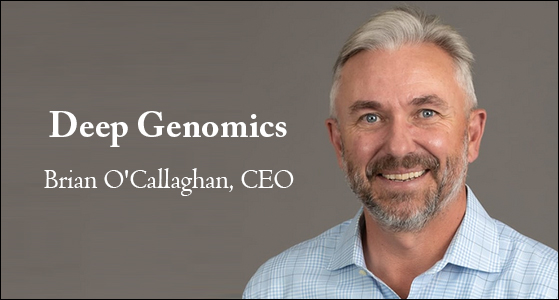
Brian O'Callaghan, Chief Executive Officer and board member
With over 30 years’ experience as a senior life science executive, Brian brings extensive knowledge within the biotech, big pharma and clinical research organization (CRO) sectors. Previously, he held CEO positions at ObsEva SA, Petra Pharma, Acucela, Sangart and BioPartners. Earlier in his career, Brian held multiple senior management positions at Pfizer, Merck Serono, Novartis, Covance and NPS Pharmaceuticals.
Brian received a Marketing Diploma from the Marketing Institute of Ireland and a Master of Business Administration (MBA) from the Henley Business School at the University of Reading.


.webp)